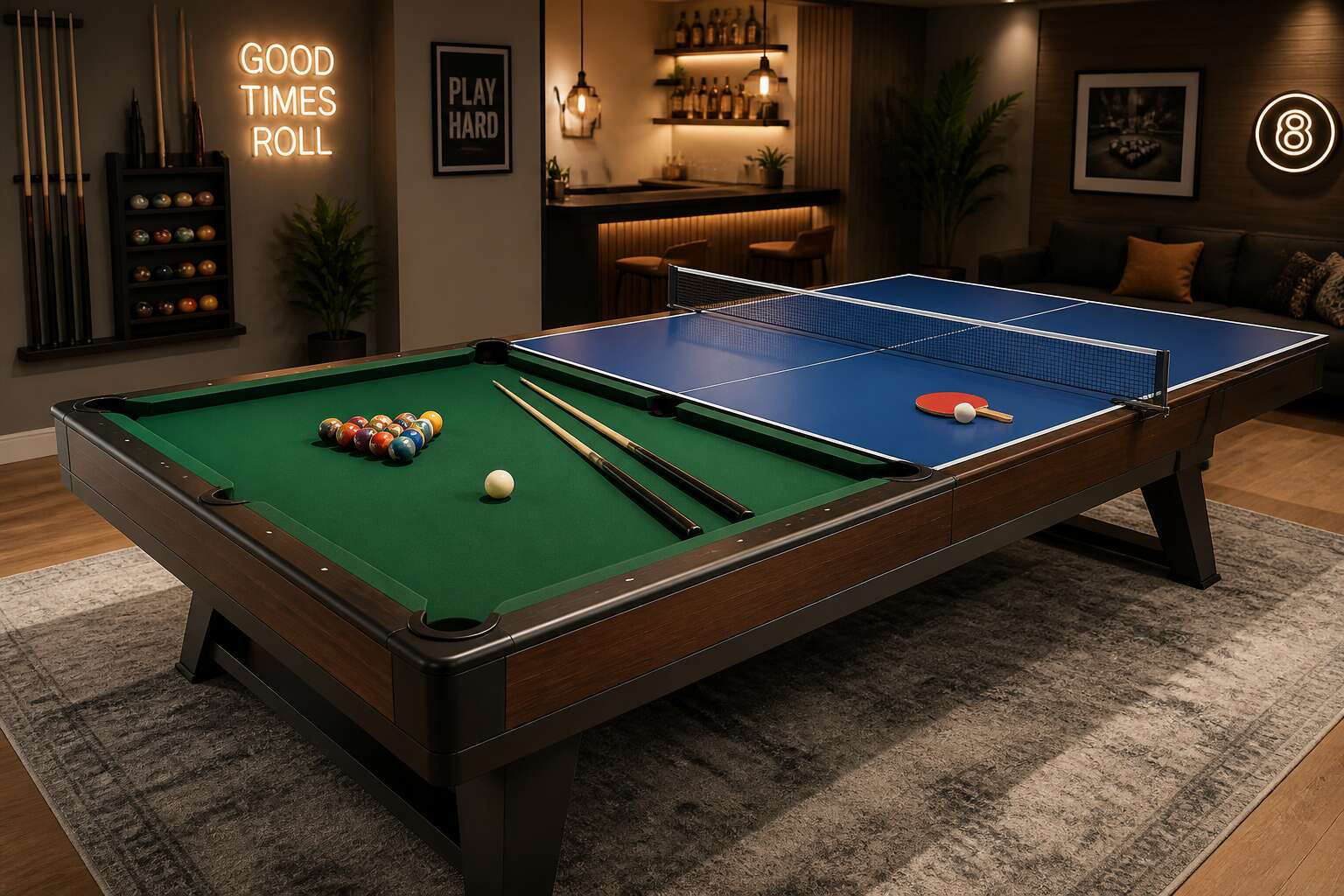
Understanding Combination Game Tables
The Growing Popularity of Multi-Use Game Room Furniture
The days of a single-purpose pool table are fading fast. Across South African homes, a pool table with ping pong now anchors evolving game rooms, delivering two experiences without doubling the footprint. The shift is practical.
Multi-use furniture answers a simple problem: limited room. For families and entertainers, converting the tabletop changes the activity. This versatility attracts anyone who values function.
- Dual play options increase usage frequency
- One frame reduces storage demands
- Conversion keeps the game room adaptable
I have noticed this trend in local showrooms. The appeal lies in choice, and the value is measured in saved space.
How a Billiard Surface Transforms into a Table Tennis Arena
The average conversion takes under a minute, but the engineering behind it deserves a closer look. Most combination tables rely on a precision-milled slate bed that sits perfectly level. When you own a pool table with ping pong, the addition of a clip-on top and a net system fundamentally alters the playing surface without disturbing the frame. The felt is protected by a durable laminate, ensuring that a stray cue ball never leaves a mark on the table tennis surface.
The process is straightforward, which is why the design proves so effective in homes across South Africa. You simply remove the net and slide the top off the rails, or you flip the entire bed if you have a reversible model. The change involves no tools and no lost parts.
– The pool table frame stays stationary, preserving the room’s layout.
– The playing height remains constant, so your strokes stay consistent.
– The net tension adjusts independently, offering proper bounce for the ping pong ball.
This tactile ritual of changing the game becomes part of the entertainment. A pool table with ping pong gives you the freedom to dictate the pace of your evening, whether you are racking the balls or spinning up a serve. The focus shifts from setup to the game itself, and that is where the real value lies. You are never stuck with one option, and your space never feels compromised.
Dedicated Tables Versus Convertible Hybrids: Core Differences
A dedicated table tennis table is a promise of a single identity. Your stroke stays the same, the rebound stays consistent, and nothing asks for readjustment between games. A pool table with ping pong instead becomes a negotiation between two disciplines. It holds more weight under the frame, carries a removable top, and stores the net in a way that constantly reminds you of the possibility of change. That simple difference decides how much preparation you welcome before a first serve.
Mechanically, a dedicated table concentrates on one flat reaction. The hybrid frame spreads its structural force across a thicker slate, a latching layer, and a string of clips. Over time, that additional engineering shows itself in the edition. Some players value that update; they enjoy the moment the surface clicks over.
- Dedicated unit: no setup, purely reactive.
- pool table with ping pong: a brief ritual, part of the active game room.
The two experiences do not promise the same flow. The dedicated table delivers certainty; the hybrid table delivers version. Neither is superior, and the correct choice lives inside your tolerance for the turning point.
Ideal Use Cases for Combo Game Tables
I once watched a friend’s pool table with ping pong divide an evening. Billiards before dinner, table tennis after. By midnight, neither group would admit they had played both. That flexibility explains where a combination table belongs.
The ideal use case is social unpredictability. A household that hosts colleagues one week and cousins the next cannot justify a single-use table. The combo table suits the townhouse with one game room, the family with varied tastes, and the host who enjoys rotating entertainment without owning two large pieces of furniture.
Key Features to Evaluate Before Purchasing
Playing Surface Quality for Billiards: Slate vs. MDF
Nearly every botched shot on a combination table traces back to an uneven bed. The playing surface is the soul of billiards, and when you add a ping pong conversion, it becomes a dual-purpose battlefield. Slate offers a dense, perfectly flat foundation. MDF, or medium-density fibreboard, presents a lighter alternative, yet it buckles under sustained moisture.
Consider the thickness. Slate slabs typically exceed 19mm, providing true roll and a satisfying, muffled thud. MDF models around 15mm flex slightly under pressure, which corrupts both ball deflection and table tennis bounce. My advice: press your palm across the entire bed before purchase. Any give signals trouble.
- Slate absorbs vibration without transmitting drift.
- MDF reacts to temperature swings with subtle warping.
For a pool table with ping pong, the surface must serve two masters without compromise. Choose slate if your room remains dry and your budget allows. You will feel the difference every single break!
Table Tennis Surface and Bounce Characteristics
Ping pong demands a different truth. A regulation ball dropped from 30 centimetres should rebound around 23 centimetres; anything less kills your rallies early.
When evaluating a pool table with ping pong, seek a bed with consistent rebound across its full span. A dead spot near the cushion frustrates more than any missed billiard shot. Surface finish matters equally. A glossy coating looks handsome in the showroom, yet it produces erratic skids. A matte, textured finish grips the ball and allows spin to develop naturally.
Consider these practical checks:
– Confirm the net posts anchor securely without wobbling during intense rallies.
– Run your hand across the seam where the conversion top meets the cushion; any lip deflects the ball.
– Test the surface with a spinning ball, not just a straight drop.
The rebound character decides whether this pool table with ping pong becomes a permanent fixture or a silent disappointment.
Conversion Mechanisms: Flip, Overlay, and Removable Tops
The conversion mechanism determines how naturally your pool table with ping pong moves between games. Flip tops pivot on hinges. Overlay tops rest directly on the billiard surface. Removable tops lift away entirely. Each approach changes the daily ritual of play.
Weight distribution deserves scrutiny. A flip top must balance evenly or the hinge wears unevenly over time. An overlay needs a level bed beneath it; otherwise the ball skids across hidden dips. A removable top requires storage space and often two people to handle safely.
Inspect the locking elements:
- Latches should seat with a positive click, not a soft press.
- Hinges need a firm stop at both open and closed positions.
- Alignment guides keep the top settling in the same spot every time.
Gas struts slow the descent of heavier tops, sparing both fingers and the playing surface. Test each mechanism before committing.
Frame Construction and Long-Term Durability
The frame of a pool table with ping pong is the skeleton upon which every game rests. A flimsy body betrays itself through rattling pockets and trembling legs, while a solid carcass stands silent and unyielding under the pressure of a leaning player. The construction is not merely about holding slate; it is about absorbing the kinetic shock of a break shot, keeping the balls true to their path across the felt. When you run your hand along the rail, you should feel density, not hollowness. That sensation is the first whisper of longevity.
Durability begins beneath the surface, where the materials resist the slow corruption of humidity and time. Medium-density fiberboard may offer a lower price, but it swells and softens when moisture seeps into the edges. Hardwoods, particularly those with a dense grain, laugh at the years. The joints matter just as much as the timber. A mortise-and-tenon connection holds firm, while a simple butt joint will groan and separate under repeated stress. Before you purchase, inspect the corners and the rails for signs of craftsmanship, for the unseen glue and screws will determine whether this piece becomes a heirloom or a headache.
To guide your scrutiny, consider these structural points:
– The pocket liners should be firmly attached, not merely stapled into place.
– The frame corner brackets must be metal, not brittle plastic.
– The shared playing surface, whether slate or wood, needs a level base that does not flex when pressure is applied to the centre.
Every part of a pool table with ping pong is a compromise between two sports. The material chosen for the top must withstand the sharp impact of a cue ball and the repeated bounce of a ping pong ball. A thick slate bed stands as the gold standard for billiards, but it adds a weight that demands a sturdy leg assembly. Conversely, a lighter top eases the conversion but sacrifices that stable, grounded feel. The true test comes in the delivery: a table that shudders when a ball strikes the cushion will fail you in both games. Look for cross-bracing and a central support beam that runs the length of the frame. Without that hidden spine, the table will bow, and the roll will never be true.
The longevity of the piece also rests in the finish. A scratch-resistant coating protects the wood from the inevitable slide of a cue stick or the careless placement of a paddle. Water rings from a sweating glass are the quiet killers of any furniture, and a proper sealant is the only defence. When you stand before this hybrid beast, ask yourself if it feels like it will outlast the trends. The great tables of old were built with a stubborn permanence, and the modern versions of a pool table with ping pong should honour that legacy. If the frame feels solid, the materials honest, and the engineering sound, you have found a companion for the long evenings. If it feels light and flimsy, it will end up as a wobbling nuisance in a forgotten corner. Choose the weight, and you choose the years.
Accessory Storage and Integrated Components
A statistic from a recent industry survey indicates that over 60% of combo table owners report losing crucial components within the first year. This loss is not a trivial inconvenience; it is the primary catalyst for a table becoming a piece of inert furniture. The accessory storage of a pool table with ping pong determines its daily utility. A table that demands you search for a paddle or a stray cue ball will inevitably see less play. The design of these integrated components is the difference between a seamless transition and a chore.
The best systems incorporate dedicated, recessed trays that cradle the table tennis net and paddles within the frame itself. These compartments are engineered for the specific dimensions of the equipment, preventing rattling and ensuring the pieces are protected when the top is converted. Consider the placement of these storage bays. A drawer that slides out from the end is accessible, but a hinged panel on the side might be easier to reach when the table is against a wall. The quality of the hinges and slides is paramount; they must operate with a smooth, firm motion to withstand years of use.
For the discerning buyer, evaluating the ancillary features is as important as the playing surfaces. The process of evaluating these features can be broken down into specific points of inspection:
– The cue rack should be lined with a protective material to prevent the shafts from acquiring dings and scratches.
– The ball return mechanism, if present, must be fitted with sound-dampening features to avoid a distracting clatter.
– The storage for the ping pong net should allow for assembly without the need for tools, and the net posts should lock into place with a positive click.
A pool table with ping pong that integrates these components with precision reveals a manufacturer’s commitment to the user experience. The best units have a designated spot for every piece of equipment, making the transition between games a fluid, almost instinctive process. When every item has a home within the table’s carcass, the table remains a central, uncluttered hub for recreation.
Space, Sizing, and Room Layout Essentials
Minimum Room Dimensions for Comfortable Play
Space planning decides whether a game room gets used. A pool table with ping pong consumes more than its own footprint. You need clearance for cue strokes, footwork, and a table tennis backswing. Cramped rooms dull the fun and damage your equipment.
For a standard 8 foot convertible model, plan for at least urns 5.5 meters of width and 6.7 meters of length. That might sound generous, butit accounts for a 30 inch cue backswing on all sides. Trust me, you need that space. If you overlook this, you will bump walls andmiss shots repeatedly!
- Switch to shorter cues for small rooms, but limit play quality.
- Place the table away from doors andwindows to avoid airflow disturbances.
- Allow extra space behind each corner for lean-in shots.
Your room shape also dictates tabletation. A narrow passage may force a diagonal setup, wasting usable space. Measure from wall to wall atore buying any pool table with ping pong. Then visualise your stance around the perimeter. This simple check tells you whether the space truly suits comfortable play.
Ceiling Height, Lighting, and Glare Management
Once you have the floor space sorted, the next hurdles are ceiling height and lighting. A pool table with ping pong conversion needs at least 9 feet of clearance for cue strokes, and even more when you switch to paddles. Low ceilings force awkward angles, which ruin both games.
For lighting, use a single pendant or LED bar centered over the table. Position it so it casts even light without shadows on the balls. Glare becomes a problem when windows face the table directly. Use curtains or blinds to control daytime light.
- Measure ceiling height before buying
- Choose adjustable lighting
- Place the table away from direct sunlight
Each step saves you from squinting or missing a shot. With these essentials, your combo table works in practice, not just on paper.
Designing a Flexible Game Room Around a Multi-Use Table
The first rule of designing a room around a pool table with ping pong is to stop thinking of the space as a rectangle with a felt-covered slab in the middle. Instead, view it as two distinct performance zones that share one physical footprint. When you convert a pool table to its ping pong top, the playing surface grows wider and longer, while the required clearance for a backhand swing becomes a tight, unforgiving mathematics problem. A standard 8-foot pool table measures roughly 44 by 88 inches, but a ping pong top adds about 6 inches to each side, pushing the total to nearly 50 by 98 inches. That means your room dimensions must accommodate the larger of the two configurations, or you will find yourself contorting around a paddle when a simple pool shot would have been fine.
To calculate the true minimum, take the length and width of the table in its largest mode, then add twice the reach of your tallest player. For most adults, that reach is between 5 and 6 feet from the edge of the table. An 8-foot combo table therefore needs a room at least 16 feet long and 12 feet wide just for comfortable play. If you have a compact 7-foot model, those numbers drop to roughly 15 by 11 feet. But this is only the baseline, because you also need room for the cues, which are 58 inches long, and the paddles, which are shorter. With a pool cue, you need a full stroke back and forward without hitting a wall, so the clearance around the table must be at least the cue length plus a few inches. For a pool table with ping pong conversion, the real challenge is that a pool stroke uses a near-vertical angle, while a ping pong stroke is horizontal. You cannot solve one problem and ignore the other.
– Measure the diagonal from each corner of the largest table mode to the nearest wall, then add 6 feet for swing room.
– Position the table so that the longest dimension runs parallel to the longest wall, which maximizes usable floor space for both games.
– Leave at least 4 feet of open space on every side, not just the ends, because a ping pong player often steps laterally during a rally.
– Account for light fixtures, ceiling fans, and wall-mounted shelves that might interfere with a raised cue or an overhead paddle swing.
The layout should also consider entry and exit flow. If the room has a doorway, the table must not block the swing path of anyone entering, nor should a player’s back face the door while taking a shot. A simple shift of the table 18 inches off-center often solves both issues while preserving symmetry for the eye. Place the table on a level subfloor, and if the room is prone to echoes, add a low-pile rug or acoustic panels under the perimeter. The rug helps with dropped balls and reduces sound, but it must be thin enough that the table legs remain stable. For a pool table with ping pong, the top surface sits at a standard height of 30 inches, so ensure the surrounding furniture, like a bar stool or sideboard, does not exceed that height within the swing zone.
Lighting plays a dual role. A single pendant light centered over the table works for pool, but it casts harsh shadows on the ping pong net. Use a linear LED fixture that runs the full length of the table, suspended 30 to 36 inches above the surface. This provides even illumination for both games, and it reduces eye strain during long rallies. Also position the light so that it does not create a glare on the white lines of the ping pong surface. A matte finish on the tabletop helps, but a slight tilt of the fixture, just a few degrees, eliminates most reflections without affecting vision.
The final piece of the room layout puzzle is storage. Since the ping pong top must be stored somewhere when you play pool, you need a dedicated rack or wall mount within arm’s reach of the table. Place it on a side wall, not behind a player’s stance, and keep the net, posts, and paddles in a nearby drawer. This prevents the dreaded search for a missing paddle mid-game. When designing a flexible game room, remember that the table is the anchor, but the room’s usability depends on the clearance, lighting, and storage that surround it. A thoughtful layout turns a simple pool table with ping pong into a dual-purpose centerpiece that serves both casual games and serious practice sessions without feeling cramped.
Comparing Brands, Price Tiers, and Value
Leading Manufacturers in the Hybrid Game Table Market
Nearly40% of South African game room buyers now prioritize a pool table with ping pong as their primary purchase, driven by the dual utility and the reality of limited urban space. However, a crucial divide exists between the budget-friendly imports flooding online marketplaces and the premium, locally distributed names that offer piece of mind. Understanding this landscape prevents a costly misstep.
The market separates into three distinct ladders. At the entry point, you will find tables priced under R8,000. These typically feature thin MDF beds and lightweight aluminum rails. They serve a purpose for casual, weekly play, but the playing surface often develops a noticeable warp under high humidity. Mid-tier options, ranging from R12,000 to R25,000, represent the sweet spot for most households. Here, you encounter thicker wooden aprons, denser particle board, and improved conversion hinges that survive the rigors of a Sunday braai gathering.
At the premium end, above R30,000, the focus shifts entirely to engineering. Look for brands that offer a slate bed, because the ping pong top should be a separate, rigid overlay rather than a magnet for dents. When comparing value, consider the warranty and the availability of spare parts. A cheap import might look identical online, but the proprietary bolts and felt quality will degrade quickly. The best value is often found in brands with local South African service centers, as they balance the cost of a pool table with ping pong functionality against the logistics of shipping heavy furniture across provinces.
Specific value indicators to scrutinize:
– Rail cushions made from pure gum rubber (not reconstituted rubber dust)
– Conversion top thickness of at least 15mm to prevent table tennis deflection
– A frame with a central apron beam to resist twisting when you lean across the baize
– Pre-drilled, threaded inserts for the net posts instead of cheap clamps
These features dictate whether your investment feels like a sturdy piece of furniture or a wobbling compromise. The leading manufacturers in this space are the ones who solve the durability problem first and the aesthetics second. They utilize powder-coated steel legs and phenolic resin surfaces on the flip tops, ensuring that the transition from a game of 8-ball to a fast-paced ping pong rally does not loosen the structure over time. Ultimately, choose the tier that matches your usage frequency, but never skimp on the quality of the bed. A wobbly frame is the fastest way to ruin a competitive ping pong match, regardless of the brand name on the side.
Entry-Level Tables Under $1,000: What to Expect
Let’s talk about the R8,000 and under crowd. This is the territory where online marketplaces shine, but buyer beware. A budget-friendly pool table with ping pong combination often hides a fatal flaw: a thin MDF bed that bows in the first humid month. You are not buying a heirloom here, you are buying a weekend experiment.
What you actually get at this price point:
– A playing surface that will likely develop a noticeable warp
– Aluminum rails that dent if you look at them sideways
– Conversion hardware that feels like a plastic toy
– Felt that pills and tears within six months of weekly play
The flip side is that these tables are undeniably cheap. If you need a casual, occasional option for the kids, the entry tier has its place. However, do not expect tournament-grade performance from a product shipped in a flat box. The warranty is often a joke, and spare parts are a myth. Weigh the gamble against the modest price tag before you click buy.
Mid-Range Models for Avid Players
For avid players, the mid-range tier separates serious equipment from casual furniture. A pool table with ping pong in this category typically costs between R15,000 and R25,000, where you finally get a slate bed instead of compressed wood. Brands such as Gamble House and Cue Sports International offer models with 16mm slate and reinforced corner brackets. The difference emerges during long sessions. Balls track straight, and the table tennis top locks firmly without rattling.
Compare these elements across brands before committing:
- Slate thickness and the quality of seam filling
- Rail rubber density, which affects bank shot consistency
- The conversion top’s weight and locking mechanism
Some manufacturers source identical components from overseas, yet final assembly varies significantly. Inspect the frame joints and the underside bracing. A stable pool table with ping pong should have cross beams at least 50mm thick. Local dealers in Johannesburg and Cape Town often keep demo units, so you can test bounce and ball roll firsthand. This hands on check remains the most reliable value indicator.
Premium Options with Tournament-Grade Components
Premium hybrids are rare, and the market reflects it. A pool table with ping pong in the R45,000 bracket should feel like two dedicated pieces. Brands such as Riley and Sheesham approach the build differently. One uses split slate; the other insists on a single slab. Both cost similar money, so component quality decides.
From my experience, the conversion top reveals the biggest gap. Some manufacturers use aluminium honeycomb cores that warp after two years. Others use laminated birch plywood with hardwood edges. The weight difference is obvious.
- Rail bolt spacing varies by brand
- Slate seam filler hardness affects durability
- Leg leveler thread pitch differs significantly
Value premium options often omit the table tennis net to fund better billiard cushions. That trade is correct for most buyers. The best pool table with ping pong delivers the same feel as its dedicated counterparts.
Care, Maintenance, and Playing Accessories
Protecting Billiard Cloth During Ping Pong Conversion
The average ping pong rally subjects a table’s surface to more abrasive contact in ten minutes than a billiards session does in an hour. This fact becomes critical when considering a pool table with ping pong, where the felt must survive both games. Ping pong balls and paddle impacts can create scuff marks and indentations on the cloth, especially around the net posts. The protective measures you employ will determine the longevity of the playing field.
An overlay top remains the best defense, as it physically separates the ping pong action from the billiard cloth. If your hybrid design uses a flip surface, ensure the underside has sufficient padding to prevent the weight of the table from pressing into the felt. For those using a removable top, consider storing it on a padded rack rather than leaning it against a wall.
- Inspect the cloth for loose threads or snags before each conversion.
- Use a microfiber cloth to wipe the surface after every ping pong session.
- Apply a felt brush to lift dust and chalk residue, but never vacuum directly on the cloth.
Protecting the cloth also involves controlling the environment. High humidity causes the timber rails to swell, which can stretch the cloth unevenly. A dehumidifier in Cape Town’s coastal climate is not excessive, it is necessary. When your pool table with ping pong is idle, always cover it with a breathable tarp. Vinyl covers trap moisture and promote mold growth, which degrades the wool fibers over time. Maintenance is less about fixing damage and more about preventing the conditions that cause it.
Must-Have Accessories for Both Sports
Owning a pool table with ping pong conversion means managing two very different surfaces in one piece of furniture. The cloth demands gentle treatment, while the ping pong top requires regular wiping to prevent dust from scratching the finish during play.
Proper care extends to the frame and legs, where moisture from humid coastal air can cause warping over time. The conversion hardware also needs periodic inspection to keep the playing surfaces level and secure.
- A quality ping pong net that attaches without damaging the billiard cloth
- Ball retainers to keep both sets organised
- A soft brush for the felt surface
- Microfiber cloths for the table tennis top
Accessories for a pool table with ping pong serve a protective role. Organised storage for paddles, cues, and balls keeps everything within reach while reducing the risk of accidental damage during transitions.
Seasonal and Long-Term Maintenance Practices
Seasonal changes affect a pool table with ping pong more than owners expect. Coastal humidity in places like Durban or Cape Town can swell wooden frames, while dry Highveld winters shrink them. Every few months, check the cleats and hinges that lock the conversion top. Tighten anything loose before it causes misalignment.
Long-term maintenance also means conditioning the wood. Apply a thin coat of furniture wax twice a year to protect the frame without leaving residues on the playing surfaces. The cloth on your pool table with ping pong needs a deeper clean each season: brush gently, then spot-clean spills with a barely damp cloth. The ping pong surface only needs wiping, but the rubber bumper around the table tennis top can perish. Inspect it for cracks. Replace sections before they split.
A simple rhythm works well:
- Spring: wax the frame and inspect the hinge mechanism.
- Autumn: check the cloth for wear and rotate the table position slightly.
That rotation evens out sunlight fading and keeps the finish uniform.

0 Comments