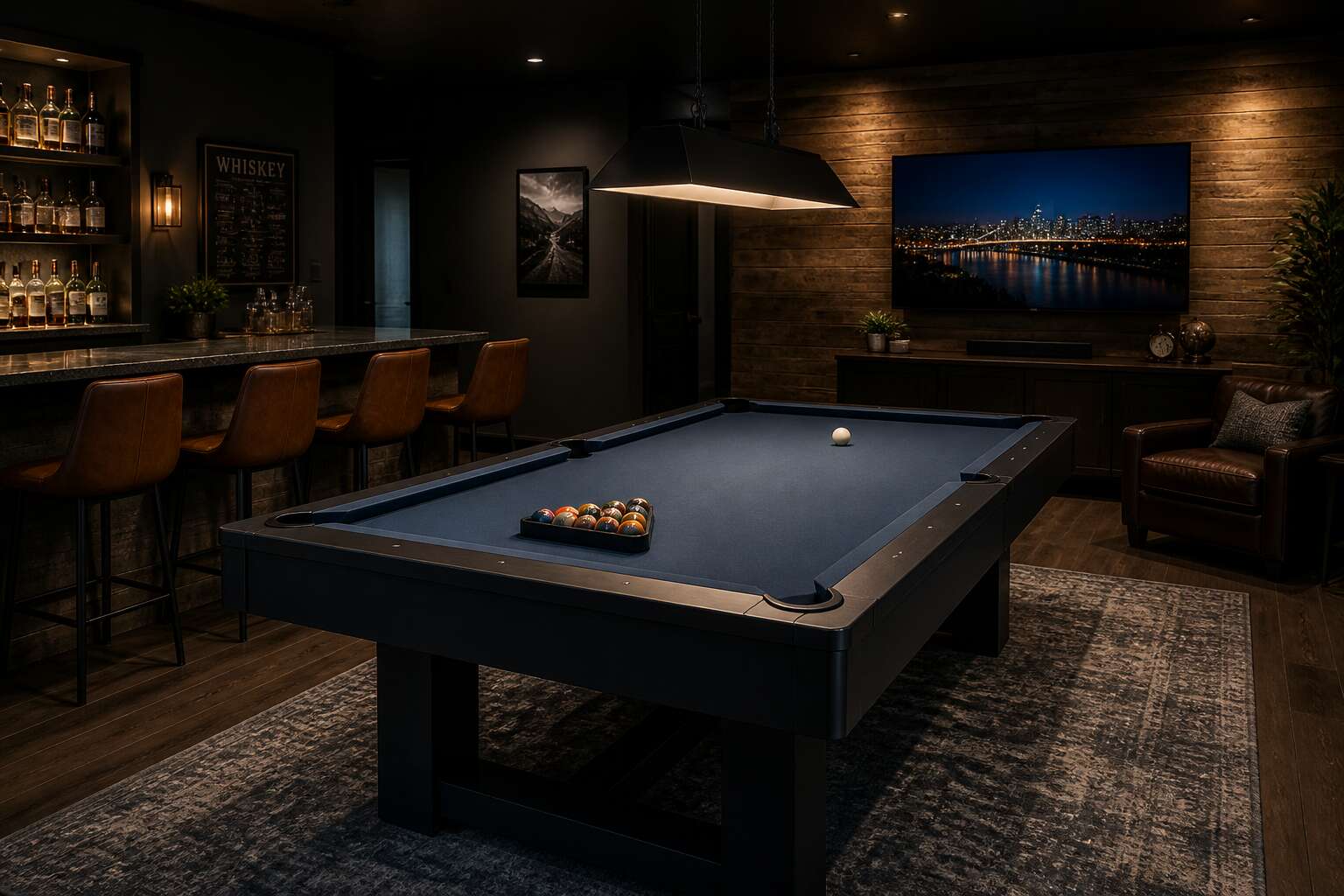
Designing the Ultimate Game Room Layout
Assessing Space and Traffic Flow
Designing an entertainment room with pool table starts with observing how people move. A cramped cue stroke ruins the game. You need at least five feet of clearance around the table on every side. That means measuring the room before choosing the slate size.
Consider these three flow principles:
– Keep the walkway behind players clear.
– Position seating against walls, not near the playing zone.
– Place the rack and cues away from the main entry path.
The pool table should anchor the space, but not block access to a bar or media console. Leave open sightlines. This way, the room feels inviting even when a match is underway.
Zone Planning for Pool and Seating Areas
Zone planning transforms an entertainment room with pool table into a cohesive experience. Rather than letting furniture drift, define clear territories. Position the pool table as the visual anchor, then arrange seating in a separate cluster, angled toward both the game and nearby conversation. Use area rugs to delineate spaces without walls. For lighting, install a pendant over the table, but keep ambient fixtures dimmer for the lounge corner. This separation prevents cues from clashing with chairs and gives spectators a comfortable perch. A well-zoned layout respects the game’s rhythm while inviting relaxation, so every corner serves a purpose. Remember, the best rooms feel intentional, not crowded.
Selecting Flooring for Durability and Style
Every entertainment room with pool table carries a certain gravity. The floor bears the weight of slate, the scuff of leather soles, and the occasional dropped cue. Concrete and porcelain tile endure the years without complaint. Sealed hardwood offers warmth but demands a protective mat beneath the playing field to avoid permanent indentations. Choose a matte finish; gloss reflects pendant light and distracts the eye during a shot.
Layout thrives on asymmetry. Angled walls and staggered seating create a deliberate unease. Keep sightlines clear from the doorway to the far pocket, but allow shadows to pool in corners. Ceiling height matters more than most realize. A low beam suffocates the room.
- Measure the diagonal before choosing a table size.
- Acoustic panels on one wall tame the clatter of balls.
- Leave a full cue length of clearance on every side.
The result feels intentional, neither sterile nor chaotic.
Incorporating Storage for Cues and Balls
Cue sticks left leaning against a wall will warp, not just physically but in spirit. Every entertainment room with pool table needs a home for its tools, a place that signals respect for the game. When balls roll loose and chalk disappears, the mind loses its anchor.
A wall mounted rack within an arm’s reach of the break position works best. Recessed shelving for balls keeps them close without inviting clutter. The trick is to store everything without letting storage dictate the room’s shape. It should whisper, not announce.
Consider these elements:
– A padded wall rack for cues
– A lined drawer for balls
– A magnetic strip for chalk and tips
– A small shelf for gloves and towels
The result is a silent rhythm. You reach, you play, you return. This room becomes a conversation between you and the table, unbroken by chaos.
Choosing the Right Pool Table
Understanding Table Sizes and Room Requirements
Choosing the table first is a common mistake when designing an entertainment room with pool table. The table’s size drives the layout, so measure the room before you shop. Common sizes include:
- 7 foot tables, ideal for casual play and smaller rooms
- 8 foot tables, the standard in South African homes
- 9 foot tables, preferred by serious players
An 8 foot table needs about 4.8 by 6 metres of clear floor space once the cue swing is accounted for. A 7 foot table fits in 4.5 by 5.5 metres.
Table size changes the game itself. Larger tables reward precision and slower play. Smaller tables suit social evenings. If the room serves primarily as an entertainment room with pool table for friends and family, a 7 foot model is the pragmatic choice. I have seen buyers regret the larger option.
The playing surface, not the outer frame, sets the room requirement. Allow 147 centimetres around the table for a standard cue. Measure alcoves and doorways too. They shrink usable space quickly.
Selecting Slate vs. Alternative Materials
Slate is the benchmark. It resists warping and delivers a consistent roll. However, it is heavy. A full slate bed can strain floor joists, especially in older homes. A lighter option, such as high density fibreboard, is easier to install. That matters for a casual entertainment room with pool table.
- Slate: best for longevity and true ball speed
- High density fibreboard: budget friendly and manageable weight
- Honeycomb core: resistant to humidity and ideal for coastal climates
I once saw a buyer who chose a 9 foot slate table for a second floor room. The delivery crew had to crane it through a window. The floor sagged within a year. For a social entertainment room with pool table, an alternative material reduces risk. The game still plays well, and the room stays safe.
Deciding on Felt Color and Quality
Nothing kills a social evening faster than felt that is frayed and stained after two months. Choosing the right cloth involves more than matching curtains. Cloth quality dictates ball speed; colour sets the mood. Tournament grade worsted wool resists pilling. A napped cloth slows the roll and shows every chalk smudge.
- Navy or green hides chalk dust better than red or burgundy.
- Worsted wool outlasts woollen blends in humid Joburg summers.
- Light colours can distract your opponent’s aim.
That last one matters! I once played on cream felt and missed every shot because the glare haloed the cue ball. For a dedicated entertainment room with pool table, the felt is second only to the slate.
Considering Style and Finish to Match Your Decor
Few pieces of furniture command a room like a pool table. Its architectural presence can anchor an entire aesthetic, turning a simple space into a destination. The style you select dictates the room’s character before a single frame is played.
A sleek, modern table with a minimalist profile and matte black or walnut finishes suits a cosmopolitan loft. Traditional designs with carved legs and ornate inlays speak to a classic, stately home. Consider the interplay of materials. A chrome or steel frame offers an industrial edge, while rich mahogany adds warmth.
Your table must coexist with the current architecture, not fight it.
– Measure the visual weight of existing furniture.
– Match metal finishes to your lighting fixtures.
– Ensure the wood tone harmonizes with flooring, not against it.
– Choose a finish that withstands the Highveld climate.
The finish also affects maintenance. High-gloss lacquer shows fingerprints and dust. A distressed look, however, hides the wear of family gatherings. Ultimately, the furniture for your entertainment room with pool table should feel like an extension of your personal taste. If the design feels right before the balls break, you have already won half the battle. The game is simply the reward.
Budgeting and Brand Recommendations
Pool table prices in South Africa swing from under R8,000 to more than R50,000. That range explains why so many buyers overspend or underspend. A proper budget protects you from both errors. When you budget for an entertainment room with pool table, the table itself should come first.
I recommend allocating your funds in three directions:
- The table itself: 60%
- Installation and levelling: 20%
- Cues, balls, and maintenance: 20%
Brands matter less than their warranties. Riley and Olhausen tables hold up well. Local South African suppliers often match them at a lower price point. Before you commit, read the warranty terms carefully.
Your entertainment room with pool table deserves a table that performs. Spend on the parts that affect play. Save on the accessories, never the slate or the cushions. And if a brand offers a five year warranty, that is worth more than a fancy name on the frame!
Lighting and Ambiance for Your Pool Room
Choosing the Perfect Pool Table Lighting Fixtures
Lighting determines whether your entertainment room with pool table feels like a tournament arena or a cosy retreat. The main fixture should hang above the playing surface, casting light across the felt perfectly. I suggest pendant fixtures with diffusers to prevent glare on the balls.
The rest of the room needs controlled, recessive layers. Dimmers are essential. I prefer separate circuits for the table lights and ambient sources, allowing you to switch moods without changing the shadow on the baize.
Consider these elements together for a balanced luminance:
– Wall sconces to wash the perimeter walls in a gentle glow
– Track lighting to highlight artwork or a wet bar area
– Floor lamps in the seating zone to create intimate pockets
Circulating light through these layers creates a consistent, even distribution. Shadow pockets disappear and the cloth appears pristine. The result is an inviting atmosphere that feels professional yet personal. Your entertainment room with pool table becomes a space where guests gather naturally, the table the undeniable centrepiece under a focused, warm glow.
Balancing Ambient and Task Lighting
A pool room’s atmosphere is decided when the lights settle into their ratios. The balance between task and ambient illumination determines whether the space feels like a tournament floor or a private lounge. In an entertainment room with pool table, the cloth should receive a focused stream of light while the walls fall into a softer luminance.
The gradient matters. A sharp drop between table and walls creates drama but strains the eyes during longer sessions. A gradual transition, with perimeter fixtures filling the middle ground, lets players move their gaze without fatigue. This balance also shapes the perceived size of the room; even a modest space reads as larger when the light reaches the walls evenly.
Three tiers of light usually work best in an entertainment room with pool table:
- Concentrated task light over the play surface
- An even wash across the walls
- Low pools near the seating
Using Wall Art and Neon Signs for Personality
The most inviting entertainment room with pool table usually has one object that makes a visitor smile: a framed lithograph, a vintage poster, or a glowing neon phrase. These pieces carry the room’s personality when the ceiling lights drop to their evening setting. Wall art catches the perimeter wash and gives the eye a resting place between shots.
A neon sign provides a low level accent. It marks the social corner near the bar or the scoreboard without stealing attention from the cloth. The glow is ambient, not assertive, and that distinction matters!
- A sign behind the seating area anchors the room.
- A piece of art above the cues rack balances the wall.
- A single neon word near the entrance sets the tone.
In my experience, restraint wins. One strong piece earns attention; five timid ones divide it. The best lighting feels intentional, and the right art completes that intention.
Acoustic Treatments for Better Sound and Comfort
The sharp crack of a cue ball carries farther than you think! In an entertainment room with pool table, that sound and laughter fill space with energy or bounce off bare walls. Lighting sets the emotional register, but its influence extends beyond visibility. The hum of a refrigerator, the echo of a missed shot, the muffled chatter of guests: these sounds shape the experience as much as light. Acoustic treatments, often overlooked, convert a cavernous space into an intimate one. Soft panels behind the seating area absorb the sharp crack of cue on ball, while a rug under the table catches the scrape of chairs. The result is a room that feels composed rather than chaotic.
Consider the interplay: dimmer switches allow you to lower the lights as evening deepens, and the room responds. Sound follows light. When the glow softens, voices lower, and the space settles into its purpose. A well tuned entertainment room with pool table rewards attention to both senses.
Accessories and Decor to Elevate the Experience
Must-Have Pool Accessories for Every Player
Once the acoustics settle, the tools of the game need attention. In an entertainment room with pool table, a single errant piece of chalk can ruin a break. I recommend phenolic resin balls for their durable, precise roll. A proper triangle rack with a snug cradle prevents frustrating scatter.
Trust me, these are non-negotiables:
- Magnetic cue ball for quick identification
- High quality talc free chalk
- Tip scuffer and shaper set
Decor should enhance play without intrusion. A vintage scoreboard adds tradition. A magnetic brush holder keeps the cloth clean and the focus sharp!
Seating Options from Bar Stools to Lounge Chairs
I have seen players lose focus because their bar stool wobbled. A stable seat matters as much as a level table. Bar stools line the wall, keeping energy casual. Lounge chairs offer a different dynamic: long conversations between racks. In an entertainment room with pool table, seating placement shapes how people watch and wait.
I prefer stools with footrails for those moments when a player studies the table. Leather or vinyl wipes clean easily, and reclaimed wood adds warmth without distracting. Some rooms use a bench along the table, but that blocks walking paths. Instead, angle chairs toward the playing area, leaving a clear lane around the cloth.
- Counter stools for compact spaces
- Low lounge chairs for deep relaxation
- Adjustable bar chairs for varying table heights
The right mix lets a guest choose their posture: upright for focus, reclined for banter. That choice matters more than any decorative accent!
Adding a Mini Bar or Snack Station
A guest’s memory of your entertainment room with pool table often hinges on the refreshment zone. I once watched a tense match dissolve into laughter because someone brought out a tray of biltong and cold gin. That moment is worth planning for.
A mini bar or snack station should sit outside the walking lane around the table, close enough for quick refills. A narrow cart against the wall works well. Stock it with glassware, a small ice bucket, and easy to hold snacks.
- Bottled craft beers
- Nuts and pretzels
- Citrus wedges
- Coasters that absorb moisture
Decor matters too. A low lamp with a warm bulb signals that the station is open. A chalkboard listing the evening’s pour adds personality without distracting from the game. Keep the surface durable, because spills happen.
Displaying Memorabilia and Trophy Shelves
A bare wall or empty shelf can undermine the atmosphere of an entertainment room with pool table. The right accessories don’t fill space; they communicate character. A trophy shelf offers more than a resting place for awards. It becomes a chronicle of your dedication, giving guests a tangible conversation starter beyond the rack and break.
To elevate the experience, curate items with intent. A vintage scoreboard adds an analog charm that digital screens cannot replicate. Framed photographs capture the intensity of memorable matches. Consider these additions:
- A wall-mounted cue rack that doubles as sculptural art.
- A rotating display for your prized, signed balls.
- A shelf for rulebooks, vintage chalk, and period decor.
Each piece should justify its presence through meaning or utility. When memorabilia reflects genuine history, your entertainment room with pool table stops being a simple game space and becomes a curated archive of shared moments.
Choosing a Game Room Theme for Cohesion
Choosing a game room theme for cohesion transforms an entertainment room with pool table from a collection of objects into a deliberate space. I have seen rooms where a mismatched rug and random wall art create visual noise. A theme, whether industrial or coastal, gives every accessory a reason to exist.
Start with a single anchor, like a vintage bar sign or a specific wood tone. Then let each piece respond to that anchor. For a safari lodge feel, use brass fixtures and leather seating. For a retro arcade vibe, add neon and chrome.
- Select a palette of two or three colors.
- Repeat materials across surfaces.
- Limit decorative items to those that support the theme.
This approach makes the entertainment room with pool table feel intentional and inviting!
Maintenance and Care for Your Pool Table
Daily and Weekly Cleaning Routines
A pool table is the soul of an entertainment room with pool table, and like any well-loved companion, it thrives on gentle attention. Neglect creeps in through chalk dust and skin oils, dulling the felt and altering the roll of every ball. The fabric is a fine weave that collects the day’s debris, and a simple ritual of sweeping or vacuuming with a soft brush attachment performs wonders. This quick act, performed each evening, preserves the play surface and keeps the room’s centerpiece looking pristine.
- Use a dedicated brush with soft bristles to sweep the cloth in the direction of the nap.
- Inspect the cushions and pockets for dust buildup or stray objects.
- Wipe down the rails with a clean, dry microfiber cloth.
Deeper care happens weekly. The cushions and pockets gather grime that brushes cannot dislodge, so a slightly damp cloth works after the nightly sweep. Avoid soaking the wood or the cloth, as moisture is the table’s adversary. The slate beneath the felt needs no intervention, but the surrounding frame does. A pause to check for loose leather pockets or small blemishes on the rails prevents minor issues from becoming grand repairs. This focused attention ensures your entertainment room with pool table remains a haven for smooth breaks and straight shots.
Managing Humidity and Temperature Levels
Wood continues to respond to its environment long after it leaves the sawmill. In South Africa’s climate, with its coastal humidity and inland dry spells, your entertainment room with pool table faces constant, silent pressure. When humidity levels shift, the wood frame expands and contracts, and over time this movement can compromise the slate’s levelness or cause the cloth to ripple.
Consider these practices for managing temperature and humidity:
- Aim for a room temperature between 18 and 24 degrees Celsius.
- Maintain relative humidity around 45 to 55 percent, using a dehumidifier in coastal regions.
- Position the table away from air conditioners, heaters, fireplaces, and direct sunlight.
A small hygrometer costs relatively little and tells you exactly where you stand. Re-leveling or refelting a damaged table costs far more. Consistency is the real priority, so pursue a stable environment, not a perfect one.
When to Re-Felt and Re-Level Your Table
Your entertainment room with pool table will reward you for a little vigilance. The felt and the slate are the two components that truly define the game, and both need attention over time.
First, watch the cloth. If you see thinning, shiny patches, or a ball that suddenly rolls off line, the felt is tired. A general rule is to re-felt every three to five years for a busy home table. Also, if a spill leaves a stain that brushing cannot lift, that is your cue to replace it. Ignoring these signs only makes the nap wear unevenly, which affects every shot.
Second, check the level. Slate is heavy and stable, but wooden frames settle as seasons change. Place a spirit level along the length and width. If the bubble drifts, adjust the levelling feet under the legs. Do this every six months. A slight wobble might not be obvious, but it will turn straight shots into frustrating misses.
Keep a simple checklist in mind:
– Inspect felt for bald spots, snags, or fading.
– Test the level before a tournament or long play session.
– Tighten frame bolts if you hear creaking.
– Always use a brush and a damp cloth, never harsh cleaners.
Your entertainment room with pool table will stay honest for years with this routine. The cue ball will glide true, and every break will feel crisp. That attention to detail is what separates a casual setup from a serious one.
Integrating Entertainment Features
Setting Up Audio and Video Systems
Setting up audio and video systems in an entertainment room with pool table requires careful placement. Speakers should be positioned to avoid echo from hard surfaces. A television mounted on a sturdy wall bracket keeps sightlines clear. For the best experience, consider these steps: first, choose a receiver with enough HDMI inputs; second, run speaker wires discreetly along baseboards; third, calibrate the subwoofer for even bass. The sound should complement the clack of balls, not overpower it. Meanwhile, a projector can transform movie nights, but only if ambient light is controlled. Dimmable sconces help. Remember that an entertainment room with pool table thrives on balance. Audio and video systems should enhance, never dominate, the social energy of the space.
Installing a TV for Sports and Movie Nights
A television anchors the social rhythm of any entertainment room with pool table. It turns a quiet afternoon into a match day, or a simple gathering into a film marathon. The trick is to position the screen so it never competes with the felt for attention. A corner mount, angled toward the lounge seating, offers the best compromise.
Consider the sightlines from the bar stools and the deep chairs. You want guests to watch a penalty shootout without craning their necks away from the action at the table. This dual focus is the magic of a well planned space. The screen becomes a backdrop, not the centerpiece, preserving the game as the primary attraction.
For the best experience, keep these mounting principles in mind:
– Use a full motion bracket so the screen can be pulled out for close viewing or tucked away flat.
– Select a screen size that fits the wall proportion, not the largest option available.
– Place the television at eye level when seated, which is lower than many expect.
– Ensure the remote sensors are unobstructed by cue racks or wall art.
Movie nights in this room take on a new texture. The dimmed lights, the muted chatter, and the quiet hum of a projector create a cinematic layer over the hardwood and slate. A high refresh rate panel reduces motion blur, which matters for fast breaks in a snooker match or rapid cuts in an action film. The shared experience, the collective gasp at a close call, finds its home here.
Adding Arcade Games or Multi-Game Tables
The right arcade game adds a magnetic pull to any entertainment room with pool table, creating a secondary hub for guests who are waiting their turn at the baize. A classic cocktail table version, housing dozens of retro titles, fits neatly against a side wall without demanding the floor space of a full upright cabinet. For tighter layouts, consider a wall-mounted digital dartboard or a tabletop foosball unit that tucks under a bench when not in use. The key is to position these additions so they enhance the room’s flow rather than disrupt it. Place them in a clear sightline from the main seating area, allowing conversation to continue comfortably across the room. To keep the atmosphere balanced, verify that the sound levels and screen glare from the new machines do not interfere with the focus required for a serious shot. Before you commit to a purchase, take a quick mental inventory:
– Measure the available perimeter space beyond the pool table’s cueing zone.
– Check for accessible power points that will not create trip hazards.
– Choose games with adjustable volume settings for flexible ambience.
– Match the cabinet finish to your existing furniture and flooring tones.
This thoughtful placement ensures the room functions as a cohesive social space. Next, we will explore how a modern multi-game table can replace several individual pieces of furniture, offering a streamlined solution for varied entertainment tastes.
Smart Lighting and Climate Control Integration
Imagine the lights dimming automatically the moment a player chalks their cue. That is the promise of smart integration in an entertainment room with pool table! Sensor-driven lighting adjusts to each game’s pace, while climate control responds to body heat and movement, keeping the air fresh during long matches.
In South Africa, where load shedding often interrupts power, I find that a well-integrated system can also manage backup sources seamlessly. The key is to unify controls into a single interface, whether voice-activated or app-based. Consider these elements:
- Motion sensors that trigger ambient lighting only when the room is occupied
- Smart thermostats that learn usage patterns and adjust cooling before guests arrive
- Automated blinds that reduce glare on the table surface
Such features transform the entertainment room with pool table into a responsive environment, where every shot benefits from consistent light and temperature.
Creating a Wireless Charging and Device Station
In any entertainment room with pool table setup, the challenge of dead batteries and tangled cords can disrupt the flow of a game night. Integrating wireless charging pads directly into the side rail shelves or the surface of a nearby console table offers a seamless solution. This approach keeps the space uncluttered and ensures your devices remain powered without sacrificing the room’s design.
Consider these practical additions to your pool room infrastructure:
– Charging pads with wooden or leather finishes that match your decor.
– Built-in USB and USB-C ports discreetly installed under the bar counter.
– Cable management trays that conceal wiring completely.
By embedding these features into the furniture itself, you preserve the clean sightlines so crucial for a good game. This thoughtful integration turns your entertainment room with pool table into a hub where connectivity and classic recreation coexist effortlessly. The result is an environment that honours the focus of the game while accommodating the modern need for constant connection.

0 Comments