Space Planning and Layout Optimization
Defining Activity Zones for Passive and Active Recreation
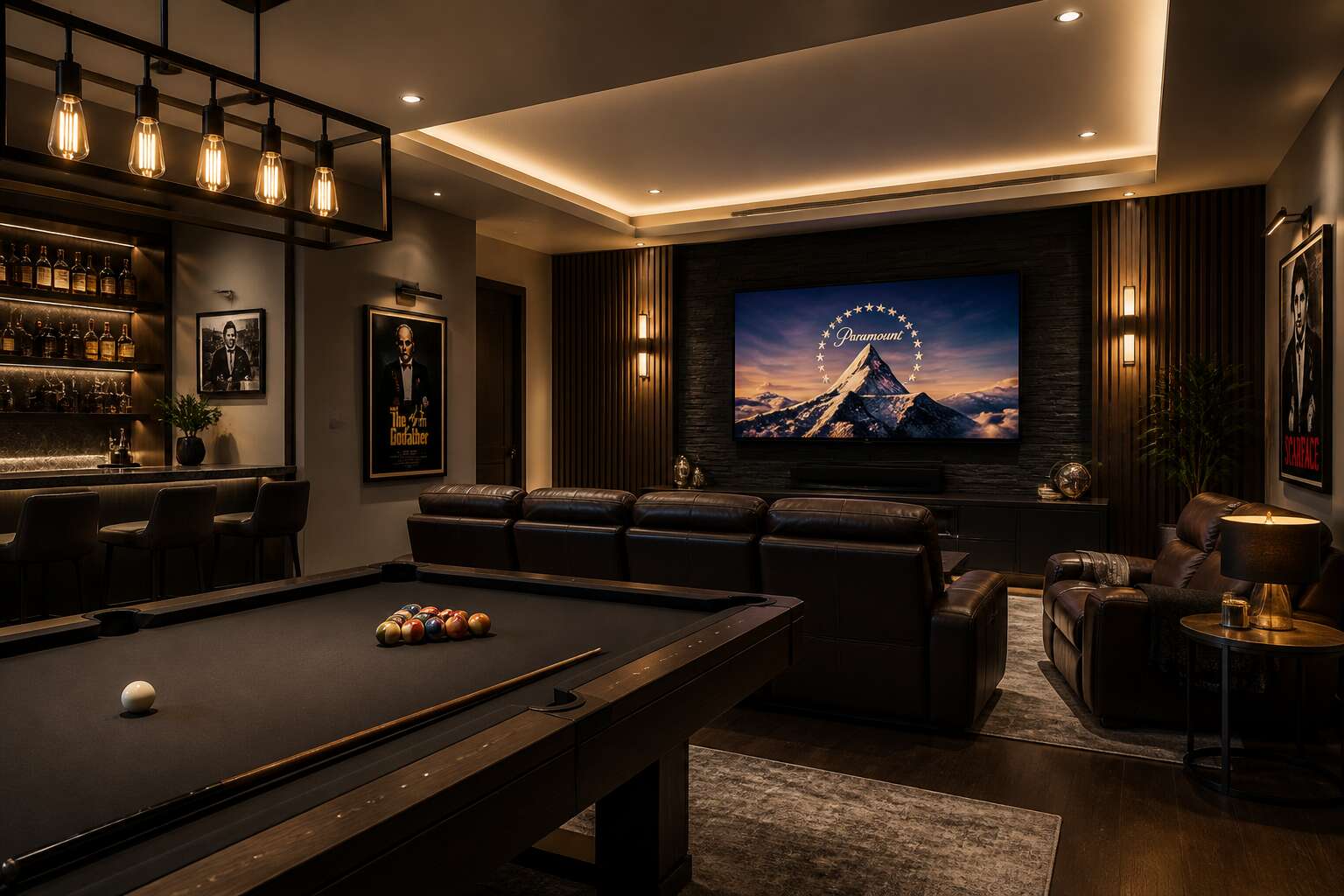
Most South African homes treat the media room as a single, static space. That is a mistake. A media room with pool table demands two distinct zones, because watching a film and taking a shot require different lighting, floor space, and traffic flow.
The passive zone, your seating and screen area, should sit on a separate plane from the active zone. Position the pool table at least 1.5 metres from the nearest sofa. That gap lets players cue freely without blocking sightlines.
For the active zone, consider:
– A low-pile carpet under the table for ball roll accuracy
– Dedicated overhead lighting that stays off the screen
Every media room with pool table benefits from this split. Define each zone with a flooring change or a dropped ceiling. The separation keeps the room functional and calm.
Measuring Your Floor Plan for Seamless Circulation
A tape measure is the most underrated tool in home design. A standard pool cue stretches 147 centimetres, so a wall hugging the table invites bruised knuckles and awkward apologies.
Before arranging furniture, measure the room’s true width and length, then subtract the table’s footprint. The remaining margin is your circulation space. A media room with pool table needs at least 120 centimetres of clear passage around the table for a comfortable stroke. Less than that, and players will contort into shapes that would embarrass a yoga instructor.
- Distance from the table edge to every wall, including alcoves and recesses.
- Swing radius of each door that opens into the room, even cabinet doors.
- Width of the walkway between the seating area and the playing area.
Once you have those numbers, trace the routes people actually use. A media room with pool table functions best when the path from the bar to the sofa does not cross the line of a shot. Mark these paths with masking tape, or better, walk the room with a friend holding a cue.
Positioning Sightlines for Television and Gameplay
A television mounted at eye level from the sofa loses its purpose if the pool table’s overhead light creates a glare. In a media room with pool table, the screen and the playing field compete for attention. Position the TV on a wall perpendicular to the table’s long axis. This keeps the cue stroke clear of the primary viewing angle.
Consider these sightline rules:
- Keep the TV’s lower edge above the pool table’s rail height when seated.
- Place the seating area at least three metres from the screen to reduce neck strain.
- Angle the table’s long side away from reflective glass or glossy surfaces.
Players need to glance at the screen without leaving their stance. The best layouts use a floating console that does not block the walkway. Every seat should have a partial view of the table, but the television remains the anchor. That balance defines a media room with pool table.
Accounting for Cue Swing Clearance and Spectator Seating
Most South African homes have a media room with pool table that looks spectacular, until someone tries to play. A standard cue needs 1.5 metres for a full swing, so the gap between the cushion and the sofa decides everything. Measure the cue’s arc, not the room’s width. Leave 1.2 metres of clear floor on each side to prevent an elbow from meeting the wallpaper.
Spectator seating requires its own logic. Put a bench along the wall opposite the television, but keep it outside the backswing zone. Otherwise a guest’s shin becomes a target. This setup lets viewers watch both the game and the screen without crowding the players. A media room with pool table works when the audience sits comfortably and the players have room to miss.
Lighting Design for Versatile Ambiance
Layered Lighting Approaches for Different Modes
The ideal light level for film viewing sits below fifty lux, while billiards requires over three hundred. A media room with pool table must accommodate both extremes without compromise.
Layered lighting solves the tension in a media room with pool table. You establish a general wash for circulation, then add task lights above the pool table felt. Accent fixtures highlight artwork or collectibles, giving depth. Dimming controls allow transitions between modes.
- Ambient layer, recessed downlights with a dimmable range from ten to one hundred percent.
- Task layer, pendant lights hung low over the table, directed at the playing surface.
- Accent layer, wall sconces or picture lights that add warmth without glare.
When I host a movie night, I lower everything to fifty lux. But before friends arrive for a pool tournament, I raise the task layer and let accent lights create a lively vibe. The switch happens at the touch of a panel.
Task Lighting Over the Playing Surface vs. Ambient Glow
A pool table demands three hundred lux on the felt, but a film needs under fifty across the room. That gap is the real test for a media room with pool table.
Task lighting over the felt stays focused, usually from pendants hung low enough to avoid casting shadows. The ambient glow serves a different function. It keeps the walls from disappearing and prevents the television from becoming a mirror.
The key lies in separation. Here is what I use to manage both:
- Dimmers on separate circuits for the pendants and the ceiling wash.
- Shields on task lights to stop upward spill onto the screen.
- Warm dimming for the ambient layer, so it doesn’t fight the projector.
I run my media room with pool table on a dedicated circuit for the task lights. For films, they cut out completely. The ambient drops to a faint outline. It is not about blending the two modes. It is about letting each activity own the visual space. No stray glare!
Installing Dimmer Systems and Smart Lighting Controls
Some homeowners treat lighting control as an afterthought, yet a media room with pool table demands deliberate separation between modes. I have found that installing dimmer systems on separate circuits changes the entire character of the space. The task lights over the felt operate independently from the ambient layer, allowing both to exist without compromise.
Smart lighting controls add another dimension. Instead of walking to a wall switch, I adjust scenes from a handheld device. One preset lifts the pendants for a competitive game, another reduces them to near nothing for a film. The transition feels seamless because it is programmed, not improvised!
Consider what a control system manages here:
- Pendant intensity over the playing surface
- The wall wash behind the television
- Accent lighting near the bar or seating
Each channel responds to a single command. A media room with pool table follows the activity rather than fighting it.
Eliminating Glare on Screens and Playing Surfaces
A single stray reflection can ruin a tense film, showing you your own fidgeting instead of the plot. In a media room with pool table, glare is the great equalizer, ruining a perfect shot on the baize and a perfect shot on the screen.
I prioritize fixtures with deep baffles and optical lenses that cut off the light at a specific angle. This keeps the screen crisp and the felt free of hot spots.
Consider the offending surfaces:
- Unfinished glass or glossy paint on the TV frame.
- High-gloss varnish on the table’s rails.
- Bare bulbs facing the seating area.
I often angle the wall sconces upward, bouncing light off the ceiling to create a soft, diffused envelope. The result is a media room with pool table where squinting is a choice, not a requirement.
Acoustic Treatment and Soundproofing
Reducing Echo for Clear Dialogue and Focused Play
A single clap in a bare room tells you everything: the echo returns in jagged, unsettled way. I’ve seen many homes sacrifice nuance to noise. In a media room with pool table, simultaneous demands of cinematic dialogue and precise game focus require controlled acoustics.
Acoustic treatment reduces reflected sound; soundproofing stops transmission. Place fiberglass panels at first reflection points, bass traps in corners, and thick carpets to quench flutter echo. A simple list of essentials:
- Dense mineral wool panels, mounted with an air gap
- Laminated gypsum board for wall damping
- Acoustic ceiling tiles to absorb high frequencies
Test each surface with a hand clap. When the slap echo softens to a dry click, orientation becomes obvious. That clarity ensures a quiet conversation stays intelligible whilea player’s focus never strays. Every cue stroke, every whispered line, lives cleanly inside itself. That is the quiet power of a well-tuned media room.
Choosing Absorptive Panels, Rugs, and Upholstered Furniture
Most owners treat soundproofing and acoustic treatment as one expense. They are not. In a media room with pool table, soundproofing keeps noise from escaping, while treatment stops sound from bouncing. I have seen rooms fail on both counts because materials were chosen for looks, not density.
Absorptive panels should be dense mineral wool wrapped in fabric. Thin foam only kills high frequencies. Rugs matter as much. A room with a pool table has hard surfaces everywhere, and the floor is the largest untreated plane.
Upholstered furniture catches low-mid frequencies that panels often miss. Choose cloth, not leather.
- Fabric wrapped panels at ear height
- Rugs over the main walkaround zone
- Upholstered seating in cloth
That material mix turns a bright room into a controlled one. The media room with pool table keeps dialogue clear and a player’s focus intact. That’s the quiet that works!
Isolating Noise from Adjacent Rooms and Floors
Sound does not travel through air only. It travels through wood framing, concrete, and water pipes. In a media room with pool table, the drop of a racked break sends vibration into the floor structure. That path leads to bedrooms and lounges below. Structural separation is the only real cure.
.
Decouple the ceiling from the joists with resilient channels. Place mass-loaded vinyl between floor layers to block airborne voices. Seal every gap around pipes, conduit, and electrical boxes with acoustic caulk. These elements matter more than fancy speakers.
From a first hand perspective, I find that most builders overlook flanking paths. A wall may be isolated, but the shared ventilation duct undoes the work. Prioritise three areas: floor underlayment for impact isolation, wall decoupling, and boundary sealing for any hidden connections. That is the difference between a room that feels private and one that leaks every cue strike.
Speaker Placement for Immersive Audio Without Distraction
Acoustic treatment in a media room with pool table goes beyond hanging panels. Speaker placement must work around the table’s mass. The slate surface can interfere with low frequencies, cancelling or reinforcing bass depending on where the subwoofer sits. Before fixing positions, walk the room while playing a familiar track. Listen for hot spots and dead zones. Then angle the front speakers so the main listening position receives direct sound, not reflections off the table bed. Height matters. Speakers at ear height keep dialogue clear, while mounts above ear height send sound over the table toward the ceiling. Diffusion panels scatter late reflections without flattening the natural acoustic of the room. That preserves the sharp crack of a break shot while keeping immersive audio intact. The goal is a soundstage that pulls you into the film, yet never competes with the game.
Selecting the Perfect Game Table
Comparing Slate, Wood, and Synthetic Surface Options
More than 80% of pool table owners say surface quality is the first thing they notice. It is often the difference between a satisfying game and a frustrating one. For a media room with pool table, this choice dictates both playability and longevity. The primary decision is between slate, wood, and synthetic options. Each material has a distinct character.
Slate remains the professional standard. Its heavy, dense core provides a perfectly flat playing field. The mass also absorbs vibration from shots, keeping the balls rolling true. Wood surfaces, often used in more affordable tables, offer a warmer aesthetic. They require a leveling system to counteract natural warping and are more susceptible to changes in humidity. Synthetic materials provide a lightweight budget alternative for casual play.
– Slate: Ensures a dead-level playing bed and consistent ball speed.
– Wood: Provides a classic look but demands careful climate control.
– Synthetic: Offers a maintenance-free option for low-intensity use.
The resilience of the cushion rubber and the cloth also factor into the overall feel. A media room with pool table functions well with a synthetic surface if the keeper plays occasionally. But for the enthusiast, a slate bed is the only real choice. Consider the room’s environment. A coastal climate with high moisture can affect wood. The initial investment in slate rewards the owner with decades of service. Select a surface that aligns with how you play. The table becomes the focal point. Your game will reflect the quality beneath the cloth.
Sizing the Table to Your Room Dimensions
A pool table chooses its room as much as you choose the table. Before any felt is laid, measure the space with cold precision. The cue becomes an extension of the arm, and an arm needs its full arc. A cramped media room with pool table is a funeral for a good game.
Consider the standard dimensions for play:
- 7-foot table: fits a room of 12 by 15 feet.
- 8-foot table: requires 13.5 by 17 feet of open floor.
- 9-foot table: demands at least 14 by 18 feet.
These figures assume a 57-inch cue. Allow extra depth for the break shot. The room’s character shifts with each square metre. A table too large looms over the space, swallowing the seating. A table too small feels like an apology. Measure the cue swing, the spectator path, and the shadowed corners. In every media room with pool table, the dimensions of the table dictate the entire layout. Get them right and the room breathes.
Choosing Cloth Speed and Cushion Performance
Cloth speed sets the pace of play. Worsted wool gives a quick, even roll; napped cloth slows the ball for relaxed rounds. The cloth should suit the room’s primary use. Choose a speed that rewards skill but forgives a distracted stroke.
Cushion performance affects every bank shot. Test each cushioned rail with the same force:
- Listen for a crisp click, not a thud.
- Watch the ball return at a predictable angle.
- Feel for even resistance along the rail.
A media room with pool table needs cushions that respond without dead spots.
Matching the Table Style to Your Interior Design
When you plan a media room with pool table, the table’s design is the central element. I always consider how the table’s frame, finish, and rail details align with your interior’s style. A traditional room uses a carved hardwood frame, while a sleek space needs minimal edges and a matte surface.
Match the table to your architectural era. For a Victorian home, choose deep mahogany with brass pockets. For an industrial loft, a dark graphite frame with steel accents works well. The cloth color also matters: deep green suits classic elegance, navy or slate fits a contemporary setting!
Evaluating Durability and Maintenance Requirements
Selecting a game table for a media room with pool table requires scrutiny beyond the surface. I have seen stunning tables fail within two years because the frame joints were weak. A solid hardwood frame with mortise and tenon joints will outlive any glued alternative.
Maintenance demands vary by material. Slate beds need occasional leveling; wood surfaces require careful polishing. The cloth is the easiest to damage. Spills happen. Invest in a quality waterproof cover.
- Check the cushion rubber density before purchase.
- Ask about replacement parts availability.
- Confirm the finish resists scratches from daily use.
In South Africa’s humidity, wood can warp. Choose kiln dried timberand sealed edges. A well built table will survive generations, not seasons.
Budgeting for Accessories and Professional Installation
Professional installation can cost more than the table itself in South Africa. A slate bed weighs hundreds of kilograms and requires a team with the right equipment. I have watched homeowners hire general workers to save money, then pay double later for levelling and cloth replacement.
Budget for accessories as a separate line item. The table is one expense; the playing experience is quite another!
- A quality cue set with a wall rack
- Aramith balls instead of cheap resin copies
- A table brush and waterproof cover
- Chalk and a scoreboard
Accessories typically add 15 to 30 percent to your total outlay. Quotes from three installers provide a realistic baseline. Delivery fees to your suburb matter, because transport costs vary widely across Gauteng and the Cape. A media room with pool table only delivers value if the playing surface is level and the cloth is tensioned correctly. Skimp on installation and every imperfect roll will remind you. A media room with pool table deserves gear that matches the investment.
Furnishings, Storage, and Climate Control
Selecting Comfortable Seating That Doesn’t Obstruct Play
A pool table does not forgive furniture. A media room with pool table needs seating that understands its role: to support spectators without ever intruding on the swing path. I prefer low chairs with wooden frames and thin cushions because they move aside when the match turns serious. A high backed recliner looks inviting, but it blocks the sightline of anyone seated behind it.
Choose pieces with these traits:
- Seat height below forty centimetres
- No fixed armrests that catch a cue butt
- A frame light enough to lift with one hand
Storage follows the same logic. A wall mounted cue rack and a shallow cabinet for balls and chalk keep the floor clear so the table stands free.
Climate control completes the arrangement. Slate, wood, and cloth all respond to humidity. A media room with pool table held near 22 degrees Celsius protects the playing surface. When the air stays stable, the cloth remains taut and the cushions keep their bounce.
Displaying and Storing Cues, Balls, and Accessories
Furnishings in a media room with pool table should respect the playing field. A low drinks table near the wall keeps glasses away from the cloth. A wall mounted cue rack holds cues vertically, so the butts never touch the floor. Choose a cabinet with soft close drawers for chalk, balls, and tip tools. The room stays ready for either activity without constant rearranging.
- Cue rack with rubber lined slots
- Cabinet for balls and chalk
- Low side table for drinks and remotes
Climate control protects the investment. Slate expands and cloth stretches when humidity rises. A media room with pool table held near 22 degrees Celsius keeps the playing surface consistent. A dehumidifier helps in coastal provinces like KwaZulu-Natal. The room becomes a stable environment for both a movie marathon and a serious frame, preserving the cushions and the cloth for years.
Maintaining Humidity and Temperature for Table Longevity
Furnishings and storage in a media room with pool table do more than look good. They affect the microclimate around the playing surface. A sealed cabinet with cedar lining resists moisture, but it must stand away from exterior walls. Glass fronted doors keep dust off cues and balls. Allow air to move freely to prevent trapped humidity from swelling the wood frame.
Climate control protects your cloth. Keep the air near22 degrees Celsius and relative humidity between40 and50 percent. A hygrometer signals when a dehumidifier should run, especially in coastal KwaZulu-Natal. For a media room with pool table, position air conditioning vents away from direct drafts. A ceiling fan on low helps circulation, but I switch it off during focused play. Maintain that range! Keep these habits:
- Check the hygrometer weekly.
- Empty the dehumidifier before film nights.
- Inspect rubber cushions every season.
Integrating a Wet Bar or Refreshment Station
Statistics show that a home bar adds perceived value, but in a Cape Town summer, the real challenge is condensation. Integrating a refreshment station into your media room demands care. I position the wet bar on an interior wall, away from the felt. The under counter fridge dumps heat, so I add a dedicated exhaust fan. Glass fronted cabinets here keep drinkware dust free, but I store them with open slats for air flow. A dehumidifier becomes non negotiable near the ice bin! For a media room with pool table, I keep a hygrometer at the table’s edge. The wet bar’s humidity fights the cloth. Consider this:
– Place the bar at least two metres from the playing surface.
– Run the fridge on an eco cycle to reduce compressor heat.
– Use a moisture barrier under the bar’s wood cabinetry.
The climate control system must account for the bar’s moisture output. I adjust the dehumidifier settings on movie nights when the drinks flow.
Decorating Walls with Art, Memorabilia, and Accent Pieces
Galleries are for quiet contemplation. A media room with pool table deserves walls that can take a beer cheer. I frame classic tournament posters and vintage ball sets, but every piece gets UV resistant glass. Cape Town sunlight fades even indirect highlights, so that glass matters. Heavy frames need toggle bolts in plasterboard. Memorabilia like signed cues or famous match tickets look better inside shallow shadow boxes. Those boxes also keep dust off valuable signatures.
Storage integrates into the decor. I use floating shelves for trophies and tournament programs, positioned away from the table’s edge. This prevents accidental cue strikes while keeping items visible. To manage humidity, I place silica gel packs behind larger frames. A small digital hygrometer on the wall near the artwork duplicates the one at the table. Every surface in a media room with pool table answers to the same climate goals.

0 Comments