Understanding pool table slate
Definition of slate in pool tables
Slate is the quiet backbone of the billiard hall. More than 90% of players notice the difference a true surface makes, they say, and that difference often begins with a single stone. ‘The surface should sing!’ cries the craftsman, a line heard in Cape Town clubs and Johannesburg lounges alike.
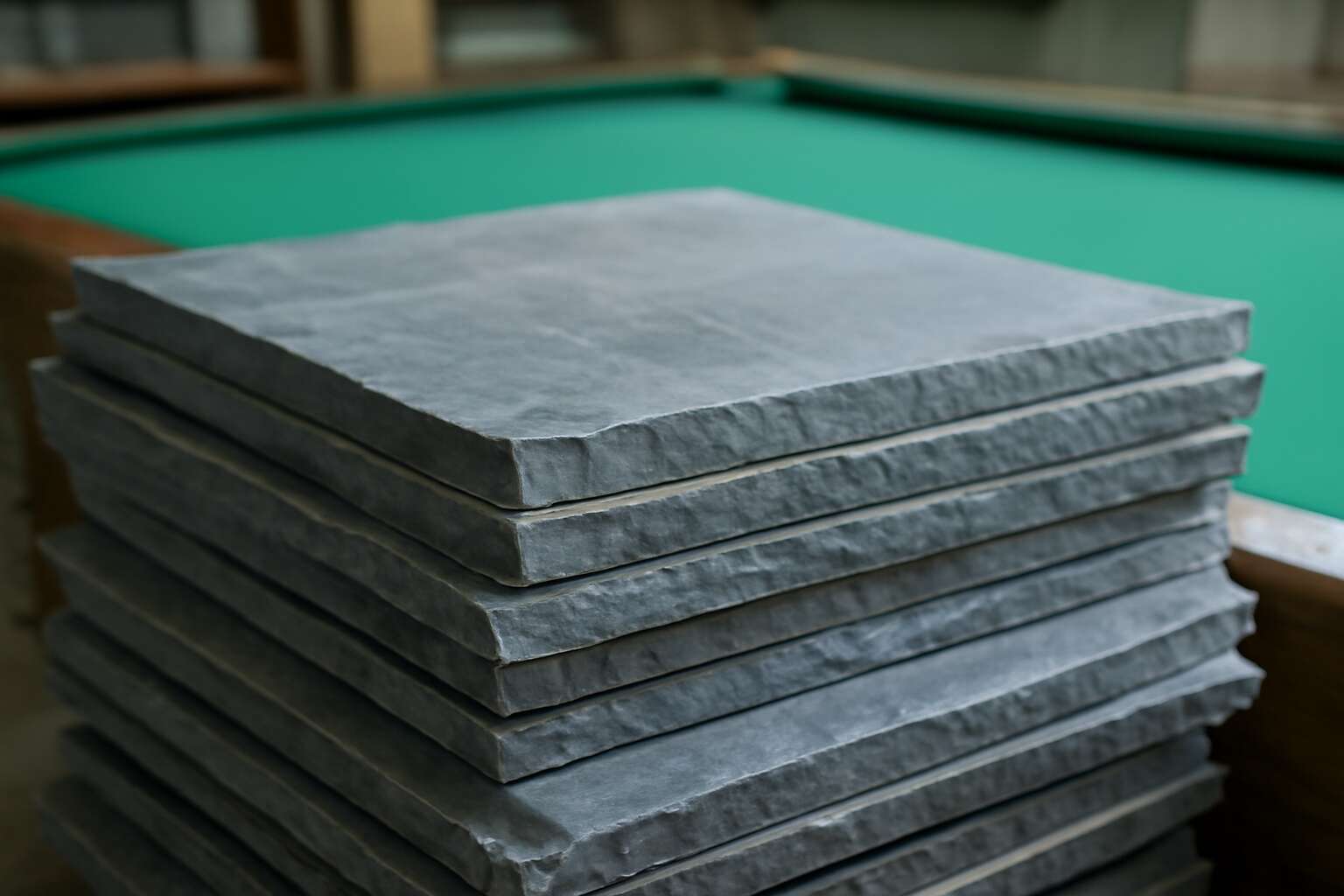
Understanding what is pool table slate means recognizing a natural metamorphic stone slab, carefully quarried and milled to uniform thickness—typically 3/4 inch or 1 inch—and joined to cover the bed with seams that vanish under chalk and time.
Key qualities that define this surface include:
- Flatness and straightness across the entire bed
- Uniform density to prevent rebound variation
- Durability under daily use and chalky residue
In South Africa, select slate is valued for local service and the confident tune it brings to clubs and pubs alike, where a true roll translates into confident shots and elegant play.
Why slate is used in billiards
Understanding what is pool table slate reveals a quiet backbone to South Africa’s billiard rooms, where the roll is judged as much by silence as velocity. The true surface steadies the game, letting shots meet cushions with a confident, almost musical hum.
Slate earns its keep through stability and predictable feedback when chalk dust swirls and crowds lean in. Its careful fabrication—from quarry to table top—delivers a surface that remains true under the daily grind of clubs from Cape Town to Johannesburg.
- Consistent roll across the bed
- Durability under chalk and foot traffic
- Seam integrity that vanishes in play
On a practical level, slate elevates the game from pastime to performance, a quiet partner that lets technique speak!
How slate affects playability and ball roll
In South Africa’s late-night billiard rooms, the first roll often tells the night’s character more than the score. So what is pool table slate? It’s the dense, flat bedrock beneath the cloth, the quiet giant that steadies the roll and guides cushions back toward their intended hum.
When the slate is true, the ball follows a more trustworthy arc, spin reads cleaner, and chalk dust becomes a backdrop rather than a disruptor. What follows is a tactile honesty that frees technique to speak rather than compensate.
- Flatness tolerance from quarry to table
- Seams that stay quiet and seamless under play
- Density that resists warping and chalk buildup
In this light, South African clubs feel less like rooms and more like sanctuaries where patience, geometry and human talk converge. I’ve watched rivals recalibrate their stance and rhythm as the slate carries the night’s rhythm!
Common misconceptions about slate materials
Understanding what is pool table slate reveals the room’s quiet backbone. Across South Africa’s late-night clubs, the surface carries the night’s rhythm with a calm, ceremonial precision. What is pool table slate becomes more than a material—it is the plane that lets cloth dance, cushions hum, and chalk fall into the right measure. A true slate yields truer arcs and softer chalk dust, a subtle poetry under strong play.
Common misconceptions about slate materials include:
- All slate is the same—density, flatness and finish vary by quarry and processing.
- One-piece slate is inherently better than three-piece; in reality, proper leveling makes both excellent.
- Seams ruin play; good installation hides seams and maintains a true plane.
- Synthetic slates exist; modern manufacturing can emulate natural slate with impressive consistency.
These ideas miss the nuance of installation, tolerances, and the quiet work that keeps a table true.
Slate vs other tabletop surfaces
“Slate is the quiet backbone of the game,” a South African pro once told me: what is pool table slate? In short, it’s the foundation that keeps cloth, cushions, and chalk dancing in measured harmony. A well-set slate makes the room feel almost ceremonial.
Slate versus other tabletop surfaces comes down to tolerance and tradition. Engineered beds and MDF can mimic a surface, but they struggle with micro-flatness, long-term stability, and resale value. A natural slate bed shrugs off warps and provides a consistent roll that players trust, shot after shot.
Consider these contrasts:
- Flatness: real slate maintains a true plane over years
- Weight and installation: proper levelling beats cheaper substitutes
- Repairability: seams and edge maintenance matter less on natural slate
Types and grades of pool table slate
Natural slate varieties commonly used
Across South Africa’s club rooms and sunlit billiard lounges, slate is the silent engine of precise play. What is pool table slate isn’t a mystery—it’s a flat, dense stone engineered to remain perfectly even under countless bumps and balls. The variety you choose influences how true the roll remains and how long the table will hold its edge.
Natural slate varieties: green-grey, blue-grey, and charcoal tones are common, each carrying a distinct grain and personality.
- Two-piece slate
- Three-piece slate
- Thickness options: 19 mm or 25 mm
Two-piece setups are popular for home rooms, while three-piece sets are favored on larger tables and in clubs where stiffness and stability matter.
Grades range from A-grade (flawless surface) to B-grade (minor imperfections) and C-grade (visible flaws), guiding durability and rebound consistency.
These choices shape how a table feels under South African cues and tournaments.
Engineered and composite slate options
In South Africa’s club rooms and sunlit billiard lounges, the phrase what is pool table slate becomes a whisper that steadies every break. Engineered and composite options reshape the landscape, offering flatness and warp resistance where tradition once reigned supreme.
Engineered slate uses stabilized layers to hold true across seasons and heavy footfall; composite slate blends crushed stone with resin for density and a friendlier price tag. On engineered and composite slates, the old A-, B-, C-grade system isn’t the same story—quality comes from precise tolerances and uniform density, not surface flaws.
- Engineered slate: warp resistance, consistent density, easy transport
- Composite slate: resin-bonded, cost-efficient, predictable roll
- Thickness options: commonly 19 mm or 25 mm for stability
Slate thickness options and what they mean
So, what is pool table slate? At a glance, it’s the solid foundation beneath every stylish break, the slab that keeps chalk-and-charm aligned when the crowd roars. When talking about types and grades, the modern market leans away from old A/B/C labels and toward strict tolerances: straightness, warp resistance, and uniform density dictate quality more than the surface sheen.
Thickness options matter: commonly 19 mm or 25 mm for stability, with 25 mm favored in higher-end clubs for durability.
- 19 mm: lighter, easier to move, quicker to level
- 25 mm: sturdier, longer-lasting, better for pro-level play
In practice, the choice ties back to venue needs and budget, ensuring a flat, predictable roll that keeps the cue ball honest and the spectators impressed.
Color, density, and quality indicators
Precision matters more than flash. Industry metrics show pro-grade tables are machined to sub-millimetre flatness, turning a brave break into a chorus of predictable rolls. The slate beneath the cue is the table’s conscience, guiding every kiss of chalk toward honest certainty!
For those curious what is pool table slate, it’s the bedrock anchoring every shot. Color ranges from greenish-gray to charcoal, signaling mineral balance. Density sits around 2.7–2.9 g/cm3, a sign of stability and warp resistance. Here are quality indicators you can read:
- Straightness and warp: true across the surface
- Density uniformity: even composition throughout
- Bed flatness: consistent true-ness between bed and rails
Today, graders favor tolerances over labels; a slate’s ability to stay straight, resist warp, and maintain density dictates how true a roll will be. In South Africa, venues balance durability with budget, choosing slate that keeps the cue ball honest and the spectacle intact.
Slate quality, thickness, and performance
Thickness standards and their impact on play
From the dim corners of South Africa’s finest clubs, a single truth lingers: the table will reveal love or fear in a single roll. The question what is pool table slate becomes a whispered creed—it’s must lie true, unwarped, to cradle a flawless line.
Thickness standards, typically 3/4 inch or 1 inch per slab, are often assembled as a three-piece slate and define the table’s heart. Heftier slate resists warping, offering a stable rebound; thinner sheets demand meticulous leveling and sturdy support to keep play consistent.
- Uniform surface across all pieces
- Crack-free edges for perfect seams
- Consistent density to prevent soft spots
Quality slate translates into predictable play, night after night, in shadowed rooms where ambition gathers like dust motes.
Flatness, trueness, and leveling requirements
Slate quality is the quiet engine behind every precise break and measured roll. Those curious about what is pool table slate will hear it described as the sturdy, stone heart that must stay flat, true, and evenly supported, or the cue ball will tell on you. The thickness of the slabs—typically 3/4 inch to 1 inch—and how they’re joined defines performance. Heavier slate resists warping; lighter sheets demand careful leveling and robust framing to keep play consistent.
To gauge flatness and trueness in a room, look for consistency across seams and a level surface that doesn’t sag in the middle. Leveling requirements demand a rigid foundation and precise shimming to maintain a true plane.
- Micron-level flatness tolerance across all pieces
- Edge integrity to avoid micro-cracks at seams
- Seam alignment that remains true despite humidity shifts
With these markers, the table offers predictable roll night after night, in clubs and homes where the air tastes of dust and ambition.
Surface finish options and how they feel
Slate quality is the quiet maestro behind every crisp break and measured roll. The table doesn’t lie—the strike tells you when the slab is flat, true, and properly supported. what is pool table slate? It’s the stone heart of the setup, usually 3/4 to 1 inch thick and built to travel with you from club to lounge. Heavier slate resists warping; lighter sheets demand a more vigilant frame to keep play honest.
Surface finish options shape how the ball feels and how the room sounds when it’s struck. A polished surface offers a silkier roll and fewer clacks, while a honed surface can give more predictable feedback in changing humidity. Matte or sealed finishes tame glare and help with longevity.
- Polished finish for a silky roll and speed
- Honed finish for steady ball contact
- Matte or sealed finish to reduce glare and combat humidity shifts
Durability: cracks, fractures, and repair options
In South Africa’s vibrant billiard rooms, the moment before the break feels like a held breath. It’s instructive to ask what is pool table slate, the stone heart of the setup, typically 3/4 to 1 inch thick, built to travel with you from club to lounge. Heavier slate resists warping; lighter sheets demand a steadfast frame to keep play honest.
- Cracks and fractures: the telltale lines from impact and moisture, how to spot them early.
- Repair options: epoxy or resin infill, professional reglueing, and, when practical, replacement planning.
- Preventive steps: a solid frame, careful handling during moves, and climate control to tame humidity.
The slate, once settled, holds its own voice in every measured roll.
Buying, installation, and maintenance of pool table slate
Choosing the right slate configuration for your table
In South Africa, the pool room is a sanctuary where the table becomes a silent forge for precision. The question ‘what is pool table slate’ is often asked by new players; it is the bedrock beneath the cloth, shaping every roll with quiet authority. The right slate configuration harmonizes with your table, room, and style of play.
- Size and configuration compatibility with your table (1-piece vs 3-piece)
- Quality indicators: flatness, joint integrity, and surface finish
- Delivery, handling, and on-site placement considerations
- Warranty, certification, and aftercare support
Installation is a ceremony of alignment, best left to seasoned hands. In SA homes and clubs, professionals coax the surface into true balance, trusting joints and mounting to hold their vow through the years of play.
Maintenance is meditation. A gentle wipe, infrequent inspection for cracks, and a stable, dust-free environment keep the slate singing. When cared for, the bedrock of your table yields countless precise shots across South Africa.
Installation basics and when to hire a pro
For the curious, what is pool table slate? It’s the quiet bedrock under the cloth that gives every roll its authority. In South Africa, slate is a pledge to precision, not a vanity trophy. Ensure it fits your table and room before you commit.
- Pre-delivery inspection for an even surface and secure mounting points
- Careful handling and professional transport to avoid cracks
- On-site leveling and seating using proper tools and workshop-grade guidance
Installation basics are best left to seasoned hands; a misaligned slate will haunt you for seasons. When you buy, demand an even surface and coordinated delivery to your venue; then rely on pros to place the table with care.
Maintenance is meditation. Wipe with a soft cloth, keep the room stable and dust-free, and inspect for cracks during the off-season. If you notice movement, call a pro—the bedrock’s balance should be trusted to experts across South Africa.
Care and cleaning routines to maintain flatness
Buying into a true pool table slate is investing in the game’s quiet core. what is pool table slate? It’s the dense, perfectly flat bed that anchors the cloth and guides every roll. Seek evenness, appropriate thickness, and a trusted supplier with solid transit options.
Installation should feel ceremonial rather than hurried. When you purchase, demand pre-delivery checks, secure mounting points, and on-site leveling guided by professionals. The goal is a seamless alignment that will endure through seasons of play and South Africa’s sunlit rooms.
Maintenance and care revolve around balance and patience. Care and cleaning routines to maintain flatness echo a ritual more than a task; keep the environment stable and inspect for signs of movement. If anything shifts, call a pro—the slate’s balance deserves experienced hands.
Troubleshooting common slate issues
In sunlit South African rooms, it holds court—what is pool table slate—dense, perfectly flat, and stubbornly level, the bed that anchors every roll and guides your cue’s destiny across felt. Its quiet gravity never complains.
Buying into slate is choosing a steadfast ally. Seek evenness, appropriate thickness, and a supplier with documented transit and pre-delivery checks that promise care as you move it home.
Installation should feel ceremonial rather than hurried, with on-site leveling guided by professionals. The aim is seamless alignment that endures through seasons of play and South Africa’s sun.
Maintenance is a patient ritual—watch for movement, keep the environment steady, and call a pro if anything shifts; slate’s balance deserves experienced hands.
- Signs of movement: creaks, gaps, or uneven cloth
- Unusual ball bounce or irregular roll
- Visible cracks or edge misalignment
Warranty, cost, and replacement considerations
When considering what is pool table slate, remember it’s the dense, perfectly flat bed that anchors every roll. Buying it means seeking evenness, the right thickness, and a supplier with documented transit and pre-delivery checks. Warranties vary, but protection as it reaches your South African home is the guarantee.
Installation should feel ceremonial, with on-site leveling guided by pros. The cost should cover transit handling and a final calibration that respects South Africa’s sun and humidity. Consider this quick checklist from trusted suppliers!
- On-site leveling and professional calibration included
- Transit damage protection and pre-delivery checks
- Transparent costs for removal and refitting if needed
Maintenance stays patient: watch for movement and edge shifts. Replacement considerations—cracks, misalignment, or shadow gaps—balance cost against repair. In SA, work with a reputable supplier who can arrange replacement slate or parts if needed.


0 Comments