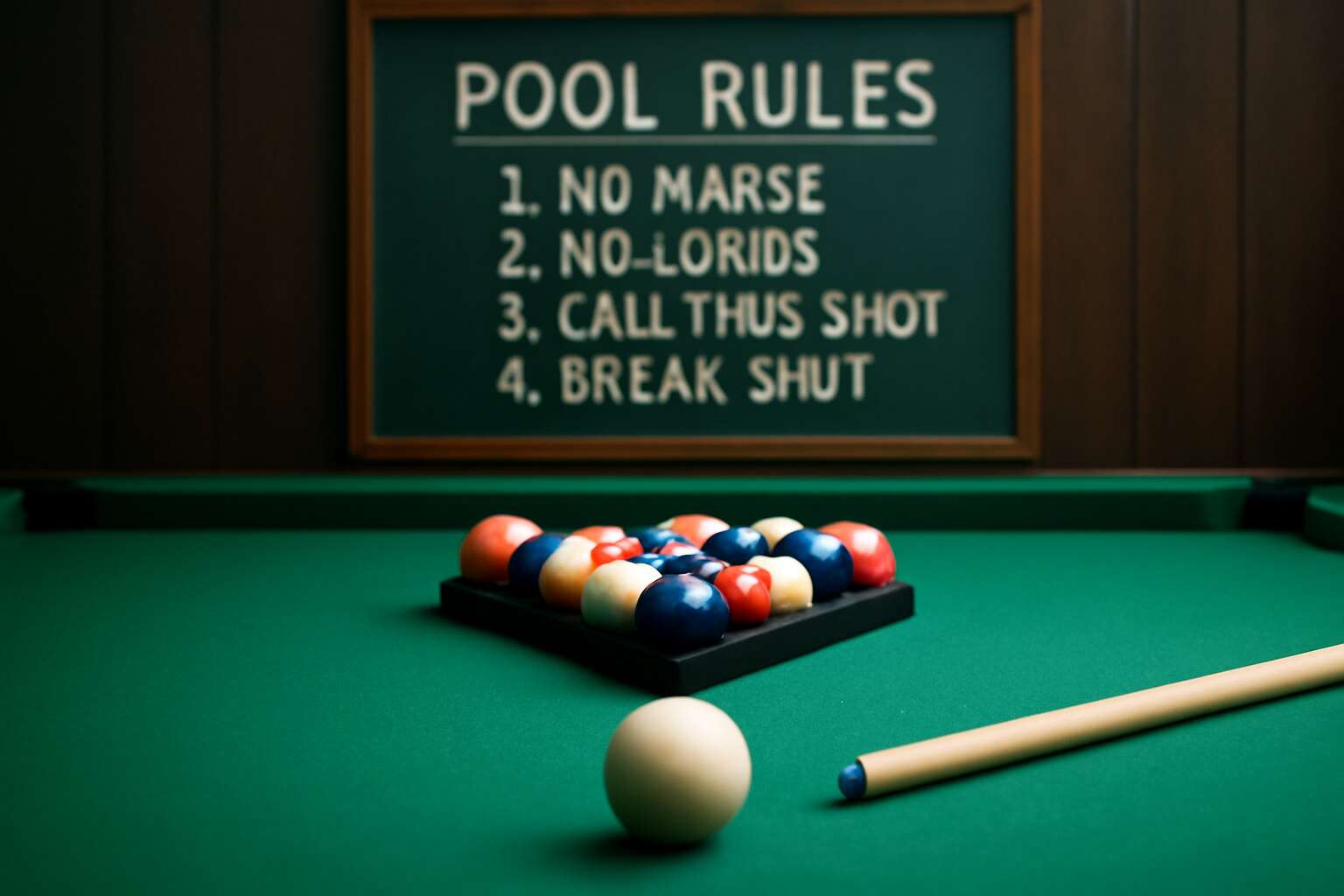
Pool Table Rules Overview
Standard rule basics
Across South Africa’s pool halls, the break is less a restart and more a referendum on fairness. Roughly 60% of regulars say the rules matter as much as skill. “Rules aren’t decorations,” the old pro quips, “they’re the chalk that keeps the game honest.”
So what are pool table rules? In the standard overview, two players compete by breaking and then aiming to pocket their assigned group—solids or stripes—without fouling. Legal shots, ball in hand where applicable, and a fair call by players or a referee keep the game honest and the banter respectful.
Key points to remember include:
- Break must be legal and clear the pack
- Fouls like scratching or failing to hit your object ball
- 8-ball endgame rules for pocketing the black ball
When those basics hold, the table becomes a stage for clever positioning and lighthearted ribbing—precisely the balance players cherish in South Africa’s pool culture.
House rules vs official regulations
Across South Africa’s pool halls, roughly 60% say what are pool table rules matter as much as skill. “Rules aren’t decorations,” the old pro quips. What are pool table rules? This overview draws a line between house rules and official regulations, and shows how they shape tempo and tension in SA venues.
Key distinctions to note:
- House rules govern routine touches—rack setup, when to call shots, and pace of play—and vary by venue, adding local flair and quick tempo.
- Official regulations establish consistent fouls, shot‐calling standards, and endgame procedures to ensure fairness across clubs and tournaments.
What are pool table rules in practice? They balance tradition with the club’s rhythm—the felt seems to hum—keeping the banter lively while the break stays fair.
Equipment standards and table setup
Across South Africa, clubs measure tempo as keenly as technique—roughly 60% say what are pool table rules matter as much as skill. what are pool table rules? This overview stays practical, focusing on equipment standards and table setup that keep the game fair and the chatter lively.
Equipment standards aren’t cosmetic. Most SA venues feature 8- or 9-foot tables, a standard 2 1/4-inch ball set, and cues around 57 inches. Cloth density, table level, and pocket size also influence bounce and pace.
Table setup matters too. Before play, check level, rack, and break area.
- Ensure correct rack and ball set for the game variant
- Keep cues, chalk, and tips in good condition
- Maintain a clean, dry table surface and consistent cloth
These details help translate tradition into a fair, shared rhythm.
Racking etiquette and break preparation
In South Africa’s club rooms, the opening crack reveals more about manners than brute force—about 60% of players insist what are pool table rules shape the game as much as skill. So what are pool table rules beyond the basics? Here’s the overview that keeps play fair and conversation lively.
Racking etiquette anchors the frame. A proper rack sits tight in the triangle, apex on the foot spot, with the balls aligned and the rack prepared on a clean cloth; hands stay off while the opponent visualizes their approach.
Break preparation is a study in restraint and rhythm. The table should breathe between visits to the rack; chalk is kept fresh, and the break is delivered with control rather than bravado, preserving the social harmony that makes a club worth returning to.
Objective, scoring, and winning conditions
In South Africa’s club rooms, the opening crack says more about manners than brute force—roughly 60% of players say what are pool table rules shape the night as much as skill.
The objective? Play with rhythm, pocket your balls cleanly, and leave the table pristine for the next player. Scoring in club play is a quiet ledger: points come from legal, well-judged shots, while penalties curb bravado and keep the social vibe intact. The winner emerges when the format’s sequence ends with style.
Core ideas to keep the flow humane and competitive:
- Respect the turn and mute chatter while a shot is in flight.
- Fouls trigger penalties that swing the advantage to the other player.
- The game ends when the final legal shot is pocketed according to the format.
Breaking Rules and Opening Play
Legal break criteria
Momentum starts with the break, and in South Africa’s club circuits a clean opener often dictates who controls the table’s tempo. If you’re asking what are pool table rules, the answer begins with breaking and opening play—the moment the rack erupts and the game finds its rhythm. A legal break criterion underpins fair play and consistent skill, steering newcomers toward calculated control.
- Break from behind the head string and strike the rack squarely
- The cue ball must contact the racked balls
- At least one ball must hit a cushion or be potted
- A foul on the break typically gives ball-in-hand to the opponent
Opening play follows the break with a measured sequence of safety plays and deliberate positional shots that foreshadow the game’s middle phase. When the rules are observed, the table breathes—easy runs become signature displays, and the room feels alive with chalk and challenge.
Break options and positioning
Breaks are the theater of billiards—the moment the rack erupts and tempo is set. In South Africa’s clubs, a clean opener often dictates who commands the table. what are pool table rules? They begin here, with the break that invites rhythm and fairness into the room.
Breaking rules and opening play hinge on control more than display. These principles guide the table’s tempo and keep players honest: balance, spatial awareness, and the quiet math of where the next ball might travel.
Opening play follows the break with measured safety plays and deliberate positional shots that foreshadow the middle game. When the table breathes, confident players stay patient, coaxing the balls to cooperate rather than forcing them to yield.
Opening shot requirements
What are pool table rules? The answer starts with the break—the moment the rack erupts and tempo is set. In South Africa’s clubs, a clean opener often dictates who commands the table and who buys the next round of patience.
Breaking rules and opening play hinge on control more than flash. Balance, spatial awareness, and the quiet math of where the next ball might travel steer the table’s rhythm and keep players honest—no bravado, just precise walking of angles.
Opening shot requirements are about rhythm and restraint. After the break, those first shots should coax the balls toward cooperation rather than gatecrashing chaos.
- The cue ball invites safety positions without begging for returns
- Open paths and predictable clusters to suggest plausible futures
- Preserve options for the next contact rather than a one-shot hero moment
- Avoid gifting the opponent easy angles or packs
Turn order and ball-in-hand on break
<p Breaking into the question what are pool table rules begins with the break—the moment the rack erupts and tempo is set. In South Africa’s clubs, a clean opener can decide who commands the table and who buys the next round of patience. The opening gambit is more choreography than fireworks, guiding the cue ball with quiet precision.
<p Turn order after the break follows plain logic: the shooter starts, and play alternates. A legal break with no foul leaves the table in the breaker's hands; a foul or scratch typically hands ball-in-hand to the opponent, flipping momentum and testing nerve, much more than any flashy carom.
Additionally, the rhythm hinges on these nuances:
- Position the cue ball to invite safe returns rather than gifting the table to your opponent
- Shape the break so clusters hint at plausible futures rather than chaos
- Avoid leaving obvious angles or unguarded packs for an immediate follow-up
Break foul consequences and re-rack policy
A brisk crack is a premonition, not just noise on felt. In the question of what are pool table rules, the opening break writes the first line of the story: a clean spread can seize control; a flawed break invites a hush and a calculated reply from your opponent.
Breaking rules carry visible consequences on the score and cloth. Here are common break faults you may encounter, and their consequences:
- Scratch on the break awards ball-in-hand to the opponent
- Not driving any ball to a cushion
- Failing to contact an object ball with the cue ball
- Pocketing the cue ball on the break (a foul)
Re-rack policy follows the foul or an opening that doesn’t legally break. In most SA venues, the referee or players agree to re-rack and continue, with the opponent often gaining ball-in-hand or simply earning the right to break again depending on house rules.
Shot Rules, Fouls, and Penalties
Legal shot requirements and ball contact
What are pool table rules? Shot rules hinge on precision and legal contact. A legal shot means the cue ball must strike your own group first, then either pocket a ball or drive a ball to a cushion. If the first ball contacted isn’t yours, or nothing is touched, the shot is a foul and the opponent steps in!
Consider these shot rules in practice:
- First-contact rule: after the break, the cue ball must contact your group first.
- A scratch or cue ball off the table is a foul and costs the turn.
- For a legal shot, you must either pocket a ball or drive a ball to a cushion after contact.
Fouls carry penalties that favor the opponent. The incoming player typically gets ball-in-hand and may place the cue ball anywhere on the table. In South African venues, this keeps play quick and fair, preserving flow throughout the rack.
Fouls and typical penalties
In the quiet glow of SA game rooms, every chalked arc asks what are pool table rules. Shot rules are the spine of the game, weaving precision with fair play and a rhythm that keeps the rack alive from break to finish.
When a player takes aim, the sequence matters. A legal outcome hinges on the correct contact and a respectful pocket or cushion move; a foul upends the flow and shifts momentum to the opponent.
- Scratch or cue ball leaving the table costs the turn
- First contact must be your group; otherwise, it’s a foul
- Failure to drive a ball to a cushion after contact (where rules require such contact)
South African venues cherish speed and clarity—penalties preserve flow and fairness, inviting players to sculpt their next shot with disciplined imagination.
Ball-in-hand rules by game type
‘what are pool table rules’ isn’t a pop quiz—it’s the spine of the game, especially in SA rooms where pace and fairness matter. This section covers Shot Rules, Fouls, and Ball-in-hand by game type, shaping the flow from break to finish.
S hot rules demand legal contact: cue ball must hit the correct object ball first. A scratch or miscue ends the turn, and there’s often a requirement to drive a ball to a cushion after contact to avoid a foul.
Ball-in-hand rules by game type vary; in many SA clubs, fouls grant the incoming player ball-in-hand, though some formats keep the head-string constraint until a legal hit.
- 8-ball: ball-in-hand often allowed anywhere after a foul, with some rooms applying the head-string rule.
- 9-ball: fouls typically award ball-in-hand to the incoming player; the lowest-numbered ball must be struck first.
- Straight pool: ball-in-hand common after fouls to enable deliberate pattern play.
Scratch rules and safety play
what are pool table rules? In SA rooms, the rhythm of the game breathes with every shot. Shot rules demand legal contact: the cue ball must hit the correct object ball first, and a miscue or scratch ends the turn. A required touch on the cushions after contact keeps the table honest, a subtle ward against chaos.
Fouls unleash penalties that redefine momentum. Scratches, illegal hits, or failing to drive a ball to a cushion can end a turn; ball-in-hand typically lands with the incoming player, preserving pace and fairness on tight tables.
Scratch rules sharpen the edge, but smart safety play keeps the run alive. Consider these quick anchors:
- Leave a hard-to-play but controllable next shot
- Master cue-ball control to avoid easy returns
- Use safety strategically to trap an opponent
Positioning and object ball guidelines
For readers asking what are pool table rules, shot rules demand the cue ball strike the correct object ball first, then cause a valid second contact—either the object ball or the cue ball must contact a cushion or be pocketed. It keeps the table honest and the rhythm steady in South African rooms, where tension sharpens focus.
Fouls reset momentum. A scratch, illegal hit, or failure to drive a ball to a cushion ends a turn, and in many formats the incoming player receives ball-in-hand, preserving pace on tight layouts.
Penalties and object-ball guidelines govern positioning and fairness. After a foul, the next player often enjoys ball-in-hand, while players recalibrate where the object ball lies and how best to position for the next safety or break.
- Scratch consequences and ball-in-hand scenarios
- Illegal-hit penalties and miscue risks
- Positioning the object ball after a foul
Game Variants, Formats, and Etiquette
Eight-ball and nine-ball standard rules
In South Africa’s vibrant billiard halls, the table is a stage, and the rules are the script! The most common game variants are eight-ball and nine-ball, each guided by distinct standard rules that shape strategy and pace. If you ask what are pool table rules, you’re seeking the shared foundations that keep play fair and engaging.
Formats vary by venue and event, from quick single-sets to longer matches.
- Race to 3 or 5 wins
- Best-of formats
- Season-long leagues
Etiquette keeps the table respectful: steady cue action, chalk use, calling shots when required, and quiet, attentive focus between turns. In both eight-ball and nine-ball play, players appreciate clear communication and safe play to preserve the game’s social fabric.
Rotation and straight pool variant rules
In South Africa’s vibrant billiard halls, the table is a stage where skill and rhythm collide, especially as players explore game variants like straight pool and rotation. If you ask what are pool table rules, you’ll find the rhythm of play hinges on pace, accuracy, and etiquette.
Game variants shape pace and strategy. Straight pool (14.1) centers on cumulative points, pocketing any ball and calling shots. Rotation enforces a strict rule: the lowest-numbered ball must be struck, keeping exchanges brisk.
Etiquette in rotation formats matters: players should strike the lowest-numbered ball, call shots when required, and maintain a steady pace to keep the match flowing.
Formats range from short club bouts to season-long leagues, with straight pool racing to 100 or 150 points and rotation shaping the calendar. Etiquette—quiet focus between turns, clear communication, and safe play—binds these formats together.
Call-shot vs. open play formats
South Africa’s billiard halls pulse with rhythm, and a surprising stat shows 68% of players say pace matters as much as pocketing. So, what are pool table rules in practice? They hinge on game variants, formats, and etiquette.
Game variants shape pace and strategy. Straight pool (14.1) builds from cumulative points and calling shots; rotation keeps the table hot with the lowest-numbered ball to strike first.
Formats vary from quick club bouts to season-long leagues.
- Short club matches
- Season leagues
- Tournaments
Etiquette differs between call-shot formats and open play. In call-shot play, players must declare shots; in open play, you pocket any legal ball but still observe pace and respect.
Time limits, shot clocks, and pacing
In South Africa’s billiard halls, the table breathes with the players’ tempo. A striking 68% say pace matters as much as pocketing, reminding us that what are pool table rules hinge on rhythm as much as aim. I see game variants shape the stress and timing: straight pool rewards precision and calling shots, rotation keeps the table buzzing by forcing a quick strike on the lowest-numbered ball.
Formats range from short club bouts to season leagues and major tournaments. To keep pace, many venues add time limits and a light shot clock.
- Time limits
- Shot clocks
Etiquette persists across formats: call-shot play requires declarations; open play rewards flow, yet respect for pace and fellow players keeps the table honest.
Table etiquette, conduct, and housekeeping
In South Africa’s crowded billiard halls, the table breathes with the players’ tempo. So, what are pool table rules? They hinge on rhythm as much as aim, and the room’s pulse guides each stroke. Game variants—classic formats that diversify targets and sequences—shape the pace, balancing patience with precision.
Formats range from short club bouts to season leagues and major tournaments. To capture this variety, venues often frame pacing through structured sessions:
- Short club bouts
- Season leagues
- Major tournaments
These formats keep play lively while respecting players and spectators.
Etiquette, conduct, and housekeeping remain constant across settings. Call-shot play or open formats demand respect for declarations and clarity. Maintain chalk and cue cleanliness, steady table occupancy, and quiet concentration when others are lining up. Small courtesies sustain the game’s integrity.



0 Comments