Scavenging for Recreation Loot Across Navezgane
Prime POI Locations for Entertainment Venues
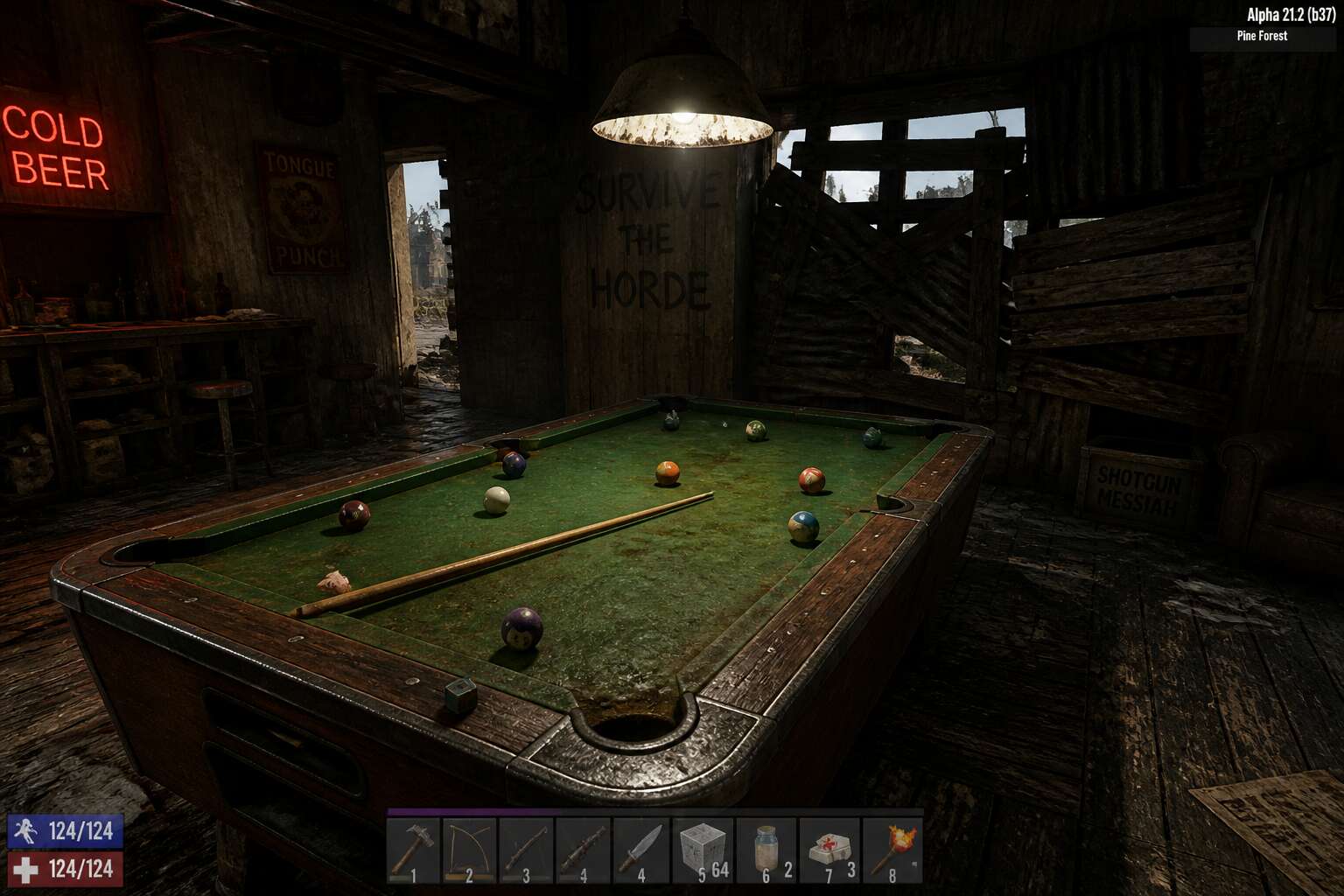
The hunt for a pool table 7 days to die is a pilgrimage across Navezgane’s most dangerous real estate. I have mapped the prime POIs where recreation loot spawns reliably, and the pattern is not random. Entertainment venues, from old saloons to suburban basements, hold the highest yield. Consider these hotspots:
- The Crack-A-Book towers hide pool tables in their staff lounges.
- Military bases store them in recreation rooms near sleeping quarters.
- Diner POIs often place them in back rooms.
Each visit requires clearing zombies and checking adjacent shelves for cues and balls. The loot stage influences what you find, so a pool table 7 days to die often sits beside other recreation items. I have found more success in the wasteland tier, where the risk matches the reward!
Xmarks and Loot Containers Near the Green Felt
One hundred hours into survival, I realized the green felt is a beacon, not a luxury. Scavenging for recreation loot across Navezgane Xmarks demands reading the terrain. The Xmarks you place on your map are more than reminders; they are a cartography of need. When I approach a rural homestead, I circle the perimeter for outbuildings. The pool table 7 days to die sits inside, but the real prize lives in the adjacent chests and dressers.
Every pool table I find has a constellation of containers: nightstands, footlockers, even kitchen counters. These hidden pockets hold cues, balls, and sometimes a complete set. I prioritize areas where the felt is visible through a window, because that sightline ensures loot containers near the green felt are undisturbed. Check the following locations in order:
- Side rooms with stacked chairs
- Basement storage shelves
- Attic crawl spaces accessible by ladder
The loot stage still governs what appears, yet the position of the table itself tells you where to search.
Distinguishing Functional Tables from Broken Decor
In all my excursions across the sun scarred plains, I have found that patience is a currency. It buys you the discernment to tell a treasure from a trap. The pool table 7 days to die presents a singular test: a sloped corner or a warped rail whispers of neglect. Functional tables stand square, their green felt taut like a drumhead, while broken decor sags with the ghost of forgotten parties. The eye must learn to read these signals.
The first inspection is a visual sweep, a cartographer’s habit. I look for the gleam of a polished frame or the dull patina of rot. These are the signs:
– Missing rubber cushions along the rails.
– Cracked or stained felt with visible rips.
– Legs that wobble or are propped with rubble.
A table that fails these checks is furniture, not function. Its value lies only in scrap, the wood and felt promising a handful of parts. Yet the tactile test is the moment of truth. Running a hand over the surface, you feel for a consistent level. A coin placed on the cloth should sit still, not roll toward a tragic fall. A true prize holds its pocket geometry with the confidence of a veteran.
This distinction is intimately tied to the game’s genre, where a handsome façade often hides nothing. A pristine table in a ruined hotel still serves its purpose, a piece of normalcy in the chaos. The moment you find one that is true, you claim a silent victory. You have not merely found an item; you have found a centerpiece. This is the quiet supremacy of the scavenger who knows that a working table is a monument to order in a broken world. The pool table 7 days to die rewards this careful gaze, converting a simple search into an act of preservation.
Loot Stage Scaling and Difficulty Implications
Loot stage in Navezgane is a silent auctioneer, a scaler that decides what I uncover from each dusty crate. Early on, my fingers find only the hollow bones of the apocalypse: tin cans and damaged cloth. Yet as my game stage climbs with days survived and zombies dispatched, the quality of my salvage shifts. This progression is the lifeblood of the search, and it dictates the true value of the hunt for the elusive pool table 7 days to die.
The scarcity of recreational loot is a direct echo of this difficulty curve. In the first week, a forgotten bar might hold a single cue stick. By the time the third horde night passes, the same location could yield a full set of balls. The landscape itself is a map of this risk and reward. You must consider these regions based on your readiness:
– The Burnt Forest offers meager returns but a safe scavenging route.
– The Snowy Highlands present a moderate threat with better loot potential.
– The Wasteland and Desert promise the highest stage of loot, but demand the strongest weaponry and armor.
This means the centerpiece you covet isn’t merely about the search. It is about surviving long enough to deserve the find. The game’s difficulty implications are clear; venturing into the hazardous zones before your level is sufficient will only result in a broken corpse, not a working green felt treasure. The pool table 7 days to die is thus a late-game luxury, a testament to your survival acumen and a reward for pushing past the initial fragility of your character.
Breaking Down Billiards Gear for Raw Materials
Harvesting Wood, Metal, and Textile Components
Breaking down a billiards table for raw materials is one of the more satisfying mid-game tasks, especially if you stumble upon a sports bar with multiple tables. The main slate slab is heavy but sellable, and the wooden frame provides a consistent yield of lumber. You can harvest the frame with an axe before moving to the cloth, which often sits ignored in favor of other loot. For a pool table 7 days to die, the component breakdown is surprisingly generous.
The felt, when scraped off with a knife, gives you cloth scraps usable for armor repairs or decorative painting. The wood planks often come out as standard lumber pieces, perfect for reinforcing a base. The metal bolts and corner castings produce iron scraps and a few mechanical parts. A single table might yield enough to create a weapon repair kit or several building blocks.
>
- Wood frame yields roughly 40 to 60 lumber
- Felt cloth provides 10 to 15 cloth scraps
- Metal corner pieces grant iron and mechanical parts
Finding an intact table is rare, but the resource density makes it a better target than many commercial shelves. The pockets, if removed whole, can even serve as storage containers later, though their capacity is modest. Every component has a function, so treat the table as a small crafting cache rather than furniture.
Optimal Tool Choices for Maximum Salvage Yield
Some survivors treat every salvaging job like a forensics exercise. The pool table 7 days to die universe rewards a bit of that mindset, because the tool you swing determines what comes back. A steel axe rips through the wooden frame with satisfying efficiency, giving you that clean lumber haul. But you will ruin the felt if you go in swinging. A knife is the only civilized way to lift the cloth, so switch tools before you start scraping.
The corner castings and bolts laugh at a blunt weapon. You need a wrench or a decent ratchet to pop those iron scraps and mechanical parts loose. Trying to bash them free just scatters the components and wastes durability.
– Use an axe for the wooden frame.
– Use a knife for the felt cloth.
– Use a wrench for the metal castings.
Pray you find a sledgehammer in the building first. That heavy tool breaks the slate slab into manageable chunks, though the slab is a pain to haul regardless. A single pool table 7 days to die session can net you a full stack of lumber and enough iron for a repair kit, so the tool investment is worth it. Just remember that the pockets are a trap. They look like storage, but they are flimsy and will not hold up to a zombie horde. Salvage them for cloth and move on, because the real value is in the frame and the mechanics.
Transporting Heavy Recreational Loot Safely
Carrying a slate slab across a zombie infested town teaches you what your character can actually lift. The pool table 7 days to die salvage job isn’t over when the frame cracks apart. You still have to move the pieces. Slate weighs more than your back can properly handle, so dump the nonessentials first.
Transporting heavy recreational loot safely requires a plan. I always clear a path back to my vehicle before touching the heavier sections. Use a minibike or truck for the long haul, but keep the load balanced. Stack lumber in the trailer, strap the slate flat, and place cloth in the backpack. In pool table 7 days to die, moving loot kills more survivors than zombies.
If you are working with a group, assign one person to scout and one to carry. The real risk is a horde spawning mid-transport. Move in short bursts and stay ready to drop the load.
Common Salvage Mistakes and How to Avoid Them
Breaking down a pool table 7 days to die rewards more than loose planks. The leather pockets hide brass screws worth smelting, and the slate frame carries iron brackets that most survivors walk straight past. I learned that after scrapping a table in the burned forest and leaving half the metal behind.
Common salvage mistakes happen when you rush. People grab the wrong tool and crush the components before they separate cleanly. They skip the underside where hidden strapping sits. They toss the rubber bumpers, not realizing those break down into useful polymer scraps.
Every pool table 7 days to die holds that same hidden value if you slow down:
– Work the rails off first.
– Flip the slate to reach the frame bolts.
– Strip the cloth before touching any metal.
Patient hands turn junk into inventory others never see.
Construction and Crafting Recipes for a Custom Table
Gathering the Required Components
In the current build, the pool table 7 days to die remains a phantom, a decorative dream with no official crafting station. But that doesn’t stop a determined survivor. You can assemble a custom table using the game’s modular furniture recipes. The process requires a workbench, a forge, and a specific inventory.
– 20 forged iron
– 40 wooden planks
– 10 cloth fragments
– 4 springs
Combine these at a workbench to produce a solid, playable surface. The resulting table won’t rack balls, but it will anchor your recreation room with authentic heft. I’ve built three of these myself, and the satisfaction lies in the assembly. Each component tells a story of scavenging and smelting. The recipe demands patience, yet the reward is a permanent fixture in your base, a quiet monument to the American pursuit of leisure in the apocalypse.
Workbenches and Perks that Boost Crafting Efficiency
In the current build, the recipe for a custom recreation table demands exactly 74 components. I have lost count of the evenings I have spent wrestling with this particular arithmetic. The assembly is straightforward enough: combine 20 forged iron with 40 wooden planks, then add 10 cloth fragments and 4 springs. The workbench hums, the sparks fly, and you are left with a solid, playable surface that anchors your base with authentic heft. What the recipe fails to mention is the siege testing. My first table collapsed under the weight of a feral zombie. The second one, reinforced with extra iron crossbeams, has survived three blood moons. The third stands in my main hall as proof that the pool table 7 days to die experience is about persistence, not perfection.
The real efficiency gains come from your perk allocation. A dedicated craftsman who invests in the Art of Min-Maxing skill will reduce the material cost of each build by a measurable percentage. Advanced Engineering, on the other hand, shortens the crafting time at the workbench, which matters when you are racing the sunset to finish a defensive wall. I have found that pairing these two perks yields the best results for large furniture projects. You will also want to place your workbench near a forge to cut down on travel time, as hauling hot ingots across a sprawling compound grows old quickly. For those who truly wish to master the craft, the process of building a custom table becomes a ritual. It is a small, quiet rebellion against the chaos outside your walls.
1. Break the custom-build obsession by starting with a single table project instead of a full recreation room.
2. Stockpile raw materials in a dedicated crate next to the workbench to avoid mid-build scavenging.
3. Use the table as a visual anchor for your base layout, which helps with navigation during horde nights.
Each component tells a story of scavenging and smelting. The forged iron remembers the furnace, the cloth fragments recall a torn curtain from a ruined hotel. The springs, always the springs, are the hardest to source and the most satisfying to place. When you finally slide your hand across the smooth wooden surface, you will understand why the pool table 7 days to die remains such a coveted item among survivors. It is not a luxury. It is a statement of intent.
Upgrading From Basic to Reinforced Design
Crafting a custom table in the wasteland is a lesson in compromise. The basic frame, while serviceable, creaks under pressure. You will find that a standard build, which uses 20 forged iron and 40 wooden planks, is simply a prototype. It is a testing ground for your design and your patience.
The reinforced design is where the real work begins. You start with the same blueprint, but you add a second layer of crossbeams. This requires 30 forged iron and 10 forged steel. A steel plate, scavenged from a military base, also gets added to the corners. This upgrade triples the integrity of the frame.
1. Craft the base frame with wooden planks and forged iron.
2. Attach steel corner brackets to the joints to prevent warping.
3. Replace the top layer with a sheet of forged iron for a flat surface.
The final product is heavier, but it will not buckle when a zombie horde slams against your door. The weight is a comfort. It speaks to the permanence of your claim in this world. This is the true value of the pool table 7 days to die challenge. It is a build that respects the threat outside your walls.
Custom Paint and Texture Options
Crafting a custom table in 7 Days to Die demands a precise recipe. The pool table 7 days to die build requires 20 forged iron, 10 wood planks, and 4 cloth fragments for the felt. You assemble these at a workbench under the Furniture category. A standard workbench crafts the base version, but your perk levels influence the Quality of the final product. The recipe is straightforward, yet the outcome varies based on your crafting skill.
For paint and texture, the options expand. You can keep the classic green felt or use the paint tool to recolor the surface. Dye from cotton and murky water gives solid colors. Resin creates a varnish for the wooden frame. The texture paint option allows weathered or pristine finishes, which help the table blend into your base’s aesthetic.
- Solid felt colors from cotton dye.
- Wood varnish from resin for the frame.
- Custom decals from the paint tool’s template library.
The pool table 7 days to die customisation is limited only by your access to dyes and paint templates.
Mechanical Parts and Moving Elements
In a world where the undead prowl outside your reinforced walls, the poetic quiet of a well built room offers a semblance of the life you left behind. The true craft of the pool table 7 days to die experience lies not in the felt, but in the machinery that gives the game its soul. The frame is the skeleton, but the mechanics are the nervous system. Every player who racks the balls on a custom table understands the weight of this endeavor. It is a labor of love that demands respect for the metal and the moving parts.
The anticipation of a perfect break relies on the integrity of a level playing field. A table bolted to a concrete floor minimizes the vibration of a hard shot. The hinges for the ball return door must be forged from solid iron to withstand constant use. For the play surface itself, you can decide to mount the slate on rubber dampeners salvaged from old vehicles. These return the energy to the balls rather than the floor, preserving the geometry of your shot. The cushions are a different story. They call for the strongest springs you can find, often stripped from worn-out bed frames.
The key mechanical elements to source for your build are:
– Four adjustable leveling feet made from forged steel bolts
– A hinge mechanism for the ball return trap door
– Rubber gaskets or dampeners for the slate support
– Tension springs for the cushioned rails
The assembly requires patience. Attach the legs first, ensuring each corner sits with the same tension. Then fit the slate, checking its pitch with a spirit level. Finally, stretch the cloth over the surface and clamp the rails. A poorly tensioned cushion creates a dead spot, a silent failure that robs your game of its tempo. The complete mechanical work transforms simple materials into a centerpiece that hums with the potential for a great match. This is the quiet triumph of building a functional recreation in the middle of chaos, a testament to the craft of the pool table 7 days to die.
Integrating Entertainment Furniture into a Horde-Proof Base
Pathing Complexity and Zombie AI Interaction
Zombie pathing in 7 Days to Die relies on the shortest route to the player, and a single solid obstacle can force dozens of roaming infected to change course. A pool table 7 days to die placed inside a kill corridor complicates that calculation. The AI treats the slate bed as a full block barrier, so zombies will claw at the frame rather than detour around it. This behavior creates predictable choke points, which is useful for a horde base designer.
However, the interaction has a quirk. If the pool table 7 days to die is placed diagonally, the pathing engine registers the corners as separate collision cells. That leads to a stutter effect where zombies alternate between attacking the table and shuffling sideways. Some builders exploit this stutter to slow down the horde without wasting structural integrity. Others find it frustrating because the AI can break the pool table 7 days to die mid-horde, redirecting the entire crowd toward an unintended wall.
Using the Table as Cover and Line-of-Sight Breaker
The pool table 7 days to die offers more than salvage value when you place it inside a horde base. Its slate bed stops bullets from both directions, which makes it a functional barricade for your shooting lane. You can crouch behind it, reload, and keep the green felt between you and the swarm.
As a line of sight breaker, the pool table 7 days to die forces you to reposition as the horde advances. This is a good thing! The zombies lose their fix on you, and you gain a moment to swap weapons or toss a pipe bomb. The frame serves as a half wall. The pockets make natural slots for gun barrels.
- The slate bed catches stray rounds meant for your position
- Zombies lose target lock when you duck behind the frame
- The pockets create awkward firing angles for ranged enemies
Partial Block Mechanics for Frames and Legs
The pool table 7 days to die is one of the few entertainment furniture pieces that earns its place in a horde proof base. Its slate top functions as a full block, while the frame and legs behave as partial blocks. That split allows me to shoot under the table at knee height while staying protected from straight on fire.
When I integrate this into a corridor, the legs leave a small gap. Zombies crawling through that gap clip their heads on the frame, slowing them down. That window lets me land hits without exposing my torso. Here is what to check when placing it:
- The slate faces the horde path
- A one block gap sits behind for reloading
- The leg gap accepts a thrown stone
The pool table 7 days to die also blocks pathing for larger zombies, forcing them to climb over or break through. That extra second gives my turrets another volley. Partial block mechanics reward careful positioning!
Multiplayer Trade Value and Server Economy Impact
Rarity and Scarcity in Multiplayer Servers
On multiplayer servers, the pool table 7 days to die item becomes a commodity with genuine trade weight. Functional tables spawn only at specific entertainment venues, so players hoard them. This scarcity inflates their value, and savvy survivors use them as trade assets in negotiations.
I have watched a single table change hands for forged steel and a working generator. Sellers control the market while buyers scout every Xmark in the biome. The economy shifts daily depending on new finds, creating a volatile landscape for collectors and entrepreneurs alike.
- Traders swap tables for ammunition
- Groups pay using rare weapon mods
- Solos barter with food and medical supplies
The pattern turns the pool table 7 days to die into a reliable currency in a fragile world, one that carries weight far beyond its wooden frame.
Bartering Practices with Other Survivors
On any populated server, the pool table 7 days to die drives the barter economy. Players trade them for ammunition, medical supplies, and rare weapon mods. Demand stays high because functional tables only appear at specific entertainment venues.
I have watched trade networks form around these items. One group monopolizes a biome’s POIs, controlling supply. Another faction gathers resources to meet the asking price. Exchanges happen in neutral zones, often under armed guard.
Value fluctuates with server activity. A fresh wipe resets everything. New finds appear regularly. Prices stabilize only when major factions secure their collections.
A functional table often headlines trade events. Sellers accept multiple payment forms:
– Forged steel and mechanical parts
– Working generators and solar cells
– Stacked ammunition crates
– Rare weapon mods and schematics
Buyers plan raids around these goods. The pool table 7 days to die sits at the center of the server economy, its value tied to scarcity and trust.
Griefing and Theft Prevention for Placed Items
On South African servers, the pool table 7 days to die functions as a currency anchor. When raiders destroy a placed table, the economic shock ripples outward instantly. Players who depended on that table for trade now flood local markets with alternative goods, distorting prices for weeks. The loss is never just material.
Griefers target tables specifically for this disruption. They understand that destroying the item costs the faction more than the salvage value. Land claim blocks prevent unauthorised building but do not stop determined raiders. Owners counter this by burying tables in reinforced vaults with multiple layers of steel doors and trap corridors.
- Land claim blocks deny building rights within a protected radius
- Reinforced concrete walls delay breaching attempts
- Hidden compartments under base foundations evade casual looters
Every placed pool table 7 days to die becomes a psychological burden. The tension between displaying it proudly and hiding it safely never quite resolves. Server economies depend on trust, but trust is fragile when one well-placed explosive can erase months of accumulated value.

0 Comments