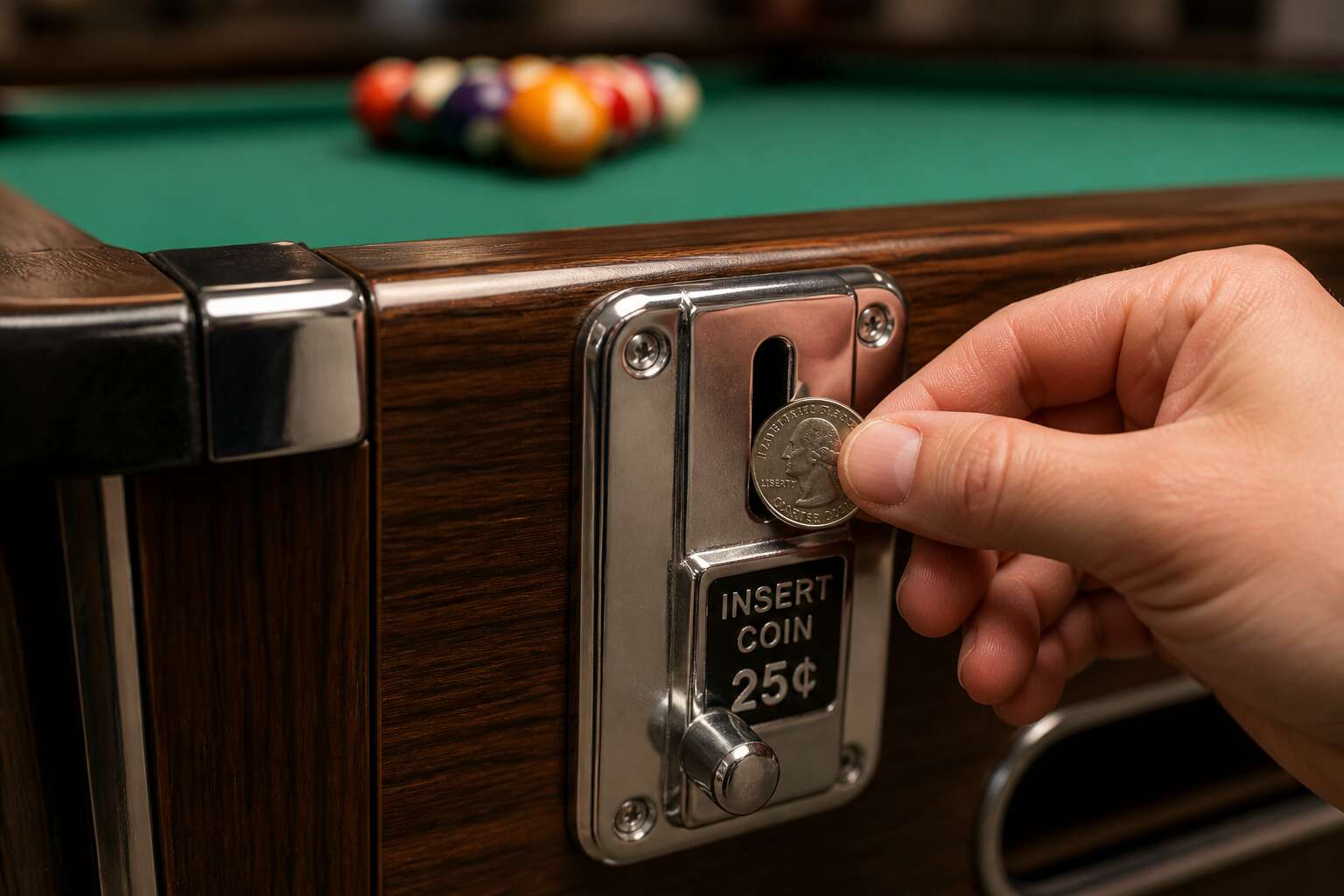
How Coin-Operated Pool Tables Work
The Role of the Coin Slot
A coin dropped into the slot of a South African pub table is more than loose change. It unlocks a precise sequence. The coin mechanism for pool table relies on a calibrated throat. Only correct dimensions and weight pass through. Once accepted, the coin trips a microswitch.
This switch activates a solenoid or lever. The lever releases the balls from the internal rack. The slot ensures the coin falls cleanly, preventing jams. The sequence is simple:
1. Insertion aligns the coin with the validator.
2. The validator checks metal content.
3. The mechanism releases the locking bar.
4. The balls roll into the return trough.
Timing remains critical. A slow fall gives the validator time to reject a slug. The coin mechanism for pool table pairs this physics with reliability. Every game starts with that single, honest drop.
Bill Acceptor Options
Most players overlook the quiet intelligence behind a pool table’s payment system. The coin mechanism for pool table remains a dependable option, but bill acceptors have become equally common across South African pubs. These devices read currency with optical sensors and magnetic ink detection. A crisp note enters the acceptor, and the device verifies authenticity in milliseconds.
I have watched players hesitate, unsure whether their worn note will pass inspection. The speed of modern bill acceptors is remarkable! They communicate directly with the table’s central processing unit. This integration lets operators track game counts, monitor revenue, and adjust pricing without opening the cabinet.
The best units accept both coins and notes, and they offer:
- Infrared scanning for paper quality
- Encrypted data ports for digital management
- Self-cleaning rollers to reduce maintenance
The choice depends on the venue’s traffic patterns and the mix of local currency.
Timing and Activation Mechanisms
The quiet click after a coin drops is the sound of a solenoid pulling back a metal gate. This is the central action of the coin mechanism for pool table activation. A signal travels to the control board, energising the solenoid for a split second. Gravity releases a full set of balls down the return channel!
The activation follows a precise order:
- Coin validation signals the central processor.
- The processor energises the solenoid, opening the gate.
- Microswitches count each ball as it returns.
- The final ball crossing the sensor resets the mechanism.
Timing matters more than most players realise. This reset prevents double releases. Some South African venues use timed play instead. The activation starts a countdown, and once the timer expires, the gate locks shut. Remaining balls stay trapped until the next payment. This mode requires precise calibration between the coin mechanism for pool table and the timer module.
Types of Coin Mechanisms
Traditional Coin Drop Units
A traditional coin drop unit uses mechanical precision to validate each coin. No screen, no sensor, just gravity and angled channels. In many South African taverns, these units remain the preferred choice because they never fail during a power outage. For a typical coin mechanism for pool table, the process starts when a coin enters the slot and slides down a steel track.
Magnets catch ferrous counterfeits. A calibrated weight gate rejects lightweight tokens. The correct coin continues, strikes a metal lever that releases the cue balls. This mechanical chain delivers instant feedback. Operators value the durability. A drop unit handles years of abuse with minimal care!
- Single coin drop units accept one denomination.
- Multi coin units allow two coin sizes on separate tracks.
- Token specific units use a unique edge profile for security.
The coin mechanism for pool table in this style requires no electrical wiring.
Electronic Card Systems
Most bar fights start over rugby, but a few start over a stolen tap card. Electronic card systems have pushed the classic coin mechanism for pool table into the background. You tap an RFID transponder on a reader, and the table releases the balls. No coins, no magnets, no weight gates. Some venues use disposable cards, others use rechargeable smart cards tied to a customer database. The reader processes the transaction in milliseconds, which keeps gameplay fluid during peak hours.
However, the system needs constant electricity. A coin mechanism for pool table only needs gravity. When load shedding hits, the card reader goes dark, but the drop unit keeps taking coins. That fundamental difference explains why many South African taverns refuse to switch entirely. Card systems do offer one clear advantage though: analytics. Every swipe records time and value, which helps an operator track busy periods. For a sharp owner, that data beats a pocket full of R5 coins.
Remote-Controlled Upgrades
Most operators who install a coin mechanism for pool table want to alter pricing without kneeling under the cloth. Remote controlled upgrades answer that. A small handset communicates with a receiver inside the drop unit. You can set the price per game, lock the table, or release the balls after a dispute.
Some systems use short range radio, others Bluetooth. The handset sits in a pocket, changing the psychology of ownership. The operator no longer walks across the room. That distance matters. A thumb click replaces a long walk.
Consider a tavern in Soweto on a Sunday afternoon. The owner watches from the counter, thumb on the button. The players see only the table, not the hand that controls the release.
When load shedding hits, the remote’s battery is the only dependency. The coin mechanism for pool table relies on gravity, but the upgrade grants remote control over timing.
Keypad Entry Systems
Keypad entry systems bypass physical currency entirely. Instead of feeding the coin mechanism for pool table, a player types a four digit code. That code becomes the token. I find this perfect for private lounges or staff-only tables.
- One time codes for a single game
- Recurring codes for monthly members
- Time-limited codes for happy hour
The keypad mounts flush on the table’s apron. It talks directly to the solenoid. This eliminates the heavy coin box and the risk of jammed slugs. Operators log every entry. The trail is clean. No bank bag required, just a keypad and a list of codes.
Mobile Payment Integration
The cellphone has become the most common object in a South African pocket, making it the natural replacement for the coin mechanism for pool table. Mobile payment integration skips the physical hardware entirely, turning the phone into the coin. A player scans a QR code on the glass, enters the table number, and the solenoid releases the balls in seconds.
In South Africa, mobile money penetration exceeds many global markets, so this integration feels like an expectation, not a novelty. The system needs no coin box, no slug rejector, and no bank bag. Every transaction is recorded digitally. Operators can set dynamic pricing without touching the hardware.
Common mobile payment routes include:
- QR code scanning with banking apps
- USSD codes for feature phones
- Contactless NFC taps from linked wallets
Each route removes the friction of carrying coins. The trade-off is a reliance on network coverage and a device in hand.
Installation and Setup
Choosing the Right Mechanism for Your Table
Nearly 70% of pool table operators in Gauteng cite installation headaches as their top frustration. The culprit is usually a poorly chosen coin mechanism for pool table. You must match the unit to your table’s dimensions and your venue’s power setup, regardless of the price tag.
Start by measuring the existing chute and checking the manufacturer’s specs. A commercial table in a busy shebeen needs a heavy duty unit, while a home table can handle a simpler design. Consider these installation points:
- Verify the mounting plate aligns with your table’s cutout
- Check if the mechanism uses AC or DC power
- Ensure the coin return chute clears the table legs
The right coin mechanism for pool table reduces downtime and prevents costly callouts. Test every coin denomination before finalising the setup. An adjustable timing module lets you fine tune the cue ball release, which can save your cushions from unnecessary wear!
DIY Installation Steps
Some operators assume installation is plug and play. It is not. The coin mechanism for pool table demands patience and precision.
Start with the basics:
- Disconnect the table’s power supply first.
- Remove the old unit by unscrewing the mounting brackets.
- Keep the shims and spacers, you may need them.
- Align the new coin mechanism for pool table with the cutout.
Secure it hand tight, then wire the power supply. South African venues often have voltage fluctuations, so double check the transformer settings. The juice must match the unit’s ratings.
Finally, run a test sequence with every coin in circulation. Five rand pieces fail differently than two rand coins. Adjust the timing module until the cue ball drops consistently.
Professional Installation Services
Somewhere in South Africa, a freshly installed coin mechanism for pool table is already failing. Not because the unit is faulty, but because it was fitted with good intentions and zero calibration. Professional installation services exist for a reason. A qualified technician understands that the cutout dimensions are only the beginning. The real work starts with the alignment, the shimming, and the electrical verification that follows. A loose bracket here, a slight angle there, and suddenly the mechanism rejects every coin you feed it.
Professional installers also bring experience with local conditions. They know how to handle the unpredictable power supply that plagues many venues.
– They check the transformer settings before wiring anything.
– They test the unit with actual South African coins, not generic samples.
– They adjust the timing module to suit the table’s specific drop chute.
This is not a task for guesswork. When a coin mechanism for pool table is installed by someone who understands the interplay between voltage, coin weight, and mechanical timing, the table performs flawlessly for years. Skipping this step often means paying for the installation twice, once for the botched attempt and once for the professional repair. Now, that is the real skill.
Wiring and Power Requirements
A coin mechanism for pool table only works if the wiring respects South Africa’s erratic grid. Voltage swings of 10% or more are common in older buildings. That is why the transformer must be verified before the mechanism receives any power. Do not trust the label. Measure the secondary output under load.
- Check the polarity of the DC supply
- Use a dedicated circuit for the table
- Set the fuse rating to the manual’s spec
Grounding mistakes cause intermittent rejections. A floating earth makes the electronics reset randomly. Also, a motorized gate draws a spike on activation. The power supply needs extra capacity, at least double the rated current, to absorb that surge without stalling.
Common Issues and Troubleshooting
Coin Jamming Problems
The rattle of a jammed coin is the most dreaded sound in any South African pool hall. It stops the game instantly and sends the owner scrambling. A simple burst coin can create a frustrating chain reaction inside the coin mechanism for pool table. Most issues start with a worn coin slipping past the gate and catching on a rough edge; the solenoid fires, yet the coin refuses to fall. A firm, controlled tap near the coin entry often clears it. But be careful. A forceful strike bends the mounting bracket and makes it worse.
Common culprits include:
– Foreign debris such as broken bottle caps or matchsticks.
– Corroded contacts that stop the coil from retracting.
– A misaligned coin slot after the table is moved.
When the jam persists, the culprit is electrical, not mechanical. A stuck relay mimics a physical blockage. Replacing the entire coin mechanism for pool table becomes the only reliable solution once internal components wear past the point of repair.
Electrical Failures
Electrical failures mimic mechanical faults. A coin mechanism for pool table that accepts coins but never trips the ball release points to a solenoid coil with broken windings. The player hears a dull thud instead of a sharp clack, telling the owner the unit receives power but cannot convert it into motion.
Before replacing anything, measure the voltage at the connector. Most South African tables run on 12 or 24 volt DC systems. A low reading indicates a weak transformer or excessive resistance in the cable run. Corroded terminals are common culprits in coastal regions.
- Test power supply voltage under load.
- Check microswitch continuity.
- Measure solenoid coil resistance.
The solenoid can fail intermittently. Heat builds up inside the housing after extended play, and a marginal coil opens the circuit once it reaches temperature. After cooling, it works again, which misleads owners into suspecting a faulty coin mechanism for pool table.
Calibration and Sensor Issues
A misaligned sensor can cost you an entire evening of play. The ball drops, the lights flash, but the release mechanism stays silent. This is the classic failure of a coin mechanism for pool table when the optical or mechanical sensors drift out of their calibrated positions.
The sensor gap on most South African tables is set at the factory. Vibration from regular play shifts that gap over time. The result is a mechanism that behaves erratically, sometimes working, sometimes not. Owners often mistake this for a deeper electrical problem, but the fix is usually a simple adjustment.
I have watched many owners bend sensor brackets to compensate for wear. This is a mistake. The bracket becomes weaker with each adjustment, and the sensor eventually fails completely. Instead, use a feeler gauge to check the gap against the manufacturer’s specification. The correct procedure is straightforward:
1. Disconnect power from the table.
2. Locate the sensor bracket near the ball release gate.
3. Insert the feeler gauge between the sensor and the flag.
4. Adjust the bracket screws until the gauge fits snugly.
Dust and grime also interfere with sensor performance. Coastal humidity in places like Durban accelerates corrosion on the sensor contacts. A coin mechanism for pool table in these regions needs frequent cleaning of the sensor faces to maintain reliable operation. The ball chute itself collects chalk dust and lint, which can obstruct the sensor beam entirely.
The controller board interprets signals from these sensors. If the board loses its calibration parameters, the mechanism may reject valid coins or fail to trigger the release sequence. This requires a recalibration procedure through the board’s diagnostic mode. A thorough understanding of your specific table model is essential, because the calibration method varies between manufacturers. Patience and precision are your best tools here.
Firmware Updates
Firmware updates are often overlooked until the machine refuses to obey. A coin mechanism for pool table might run perfectly for years, then fail after an update that was meant to refine coin validation. The board accepts the new code, but the timing parameters shift, and the release gate behaves erratically.
Common issues include interrupted updates during load shedding, corrupted files from unreliable flash drives, and version mismatches between the controller and the bill acceptor. When the mechanism freezes mid-cycle, do not assume the hardware is dead. The fix is methodical.
- Check the firmware version against the manufacturer’s latest release.
- Reinstall the update using a fresh, formatted USB drive.
- Perform a factory reset before reloading the configuration.
Most tables respond to this sequence. A coin mechanism for pool table that refuses to wake after an update usually requires a complete reflash, not a replacement board.
Maintenance and Longevity
Cleaning Best Practices
The average bar room air carries a particulate load that settles on every horizontal surface, and a coin mechanism for pool table is a prime collector. Routine cleaning of a coin mechanism for pool table requires more than a cursory wipe. Chalk dust and airborne grease form a film that dulls optical sensors and adds friction to the mechanical drop path.
Start with a dry brush to dislodge loose debris from the entry chute and the internal rails. Use a microfiber cloth with isopropyl alcohol on the sensor windows and the contact plates. Do not introduce lubricants into the coin path; they attract more dust.
- Disconnect the power supply before opening the housing.
- Brush the complete coin path from slot to drop unit.
- Clean optical lenses with a dry swab.
The surrounding environment dictates the frequency. A table near a door or a ventilation shaft will need a weekly schedule. A dedicated maintenance regimen prevents the slow degradation that leads to intermittent failures, preserving the longevity of the entire system.
Preventative Maintenance Schedule
A pool table mechanic in Soweto once told me that most coin mechs fail from boredom. Not the machine’s boredom, the owner’s boredom. They clean it once, then forget it for two years. A coin mechanism for pool table needs a calendar as much as a cloth. Preventative maintenance is the practice of fixing things before they break, and it relies on rhythm.
The working schedule for a busy bar looks something like this:
- Weekly: test the drop path with five standard coins.
- Monthly: check the sensor alignment and inspect the wiring.
- Quarterly: remove the entire mechanism and check for worn springs.
Geographic location changes the math. A coastal bar in Durban deals with salt air that corrodes contacts faster than inland venues. A table next to a braai area sees more airborne fat than one near the restrooms. The schedule is a starting point, not a law. The coin mechanism for pool table will tell you when it needs attention, usually with a jam at the worst possible moment.
Replacing Worn Parts
A coin mechanism for pool table is built from components that wear at uneven rates. The return spring loses tension after roughly one hundred thousand cycles. Roller pins develop grooves that catch the edge of a coin. The escutcheon plate thins from repeated contact and can eventually let a coin slip past its guide rail.
Replacement parts must match the original tolerances. A spring with a thicker wire gauge changes the force curve, and the mechanism might reject coins it once accepted. When you replace one worn component, inspect the adjacent parts while everything is disassembled. This matters in high-usage tavern environments where the mechanism processes thousands of coins per week.
- Return springs
- Roller pins and bushings
- Escutcheon plates
- Coin guide rails
Each swap is straightforward with the manual on hand. The coin mechanism for pool table outlasts the table when worn parts are replaced before they damage the frame.
Upgrading to Modern Systems
A pool table coin mechanism endures roughly fifty thousand insertions before its spring loses temper. That is the quiet truth bar owners learn too late. Upgrading to modern systems, particularly electronic coin validators, removes the mechanical stress that kills traditional mechanisms. With fewer moving parts, the coin mechanism for pool table no longer needs the same obsessive cleaning routine.
You still inspect it monthly, but the ritual becomes shorter. Modern units also log usage data, so you know when a component is fading. This predictive approach beats waiting for a jam mid-game. In my experience, a converted table spends less time out of service than a faithful old drop unit ever did. Longevity, it turns out, comes from changing what you maintain! A durable coin mechanism for pool table is not a fixed object; it is a choice refreshed by each upgrade.




0 Comments