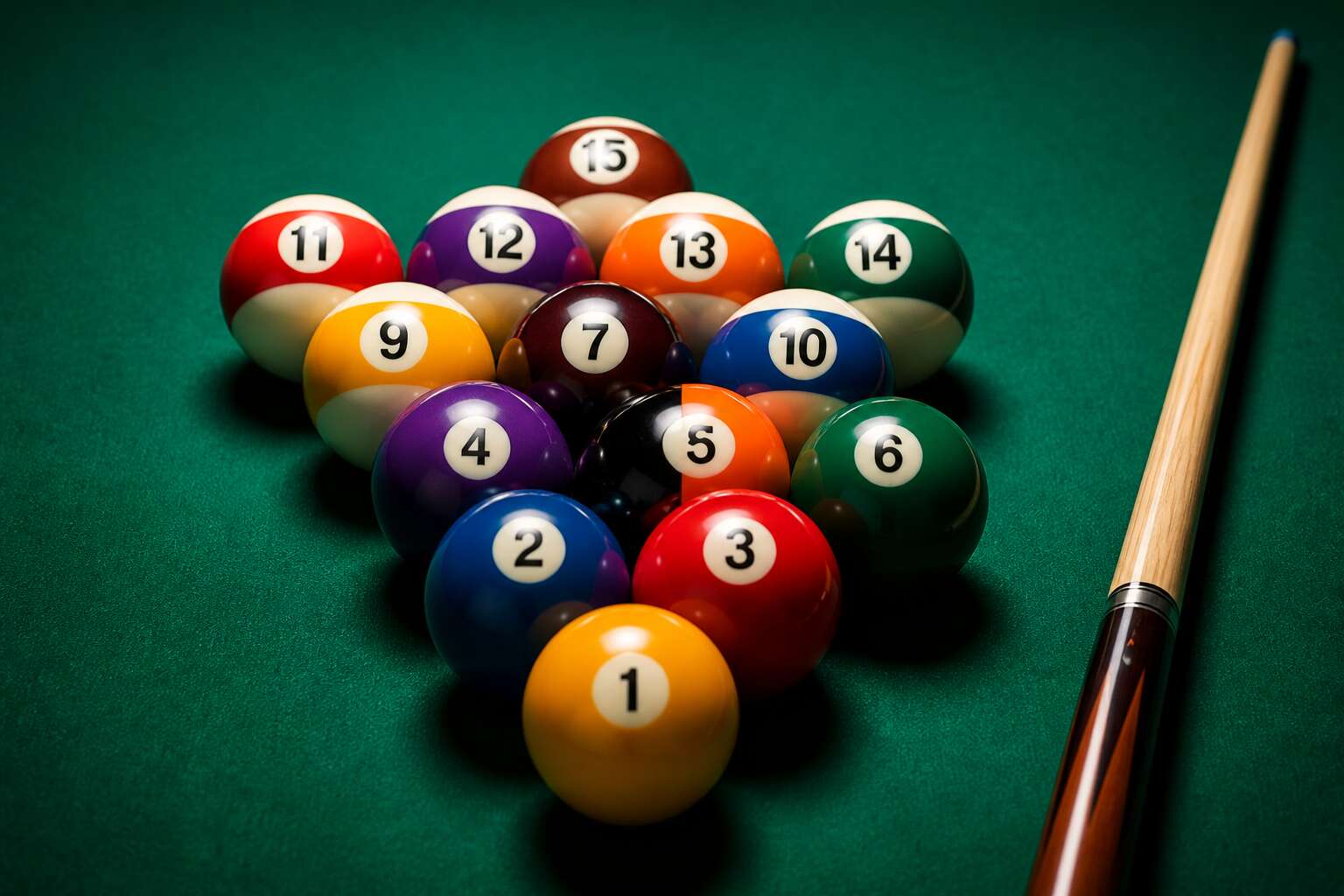
Understanding Billiard Ball Construction
Materials Used in Modern Ball Manufacturing
I have seen a pool table ball set stay flawless for decades, while another develops visible defects within a season. The difference lies in manufacturing materials. Tournament grade sets often use phenolic resin, a thermoset plastic cured under high heat and pressure. This creates a dense shell that resists chipping and holds a glossy finish for years.
Two materials dominate modern production:
- Phenolic resin, valued for high durability and consistent bounce.
- Polyester resin, an economical option that tends to crown.
The core construction also matters. Some makers add metallic fillers for balance, while others use a solid homogeneous cast. The curing cycle influences how the ball rebounds off the cushion!
Comparing Phenolic Resin and Polyester Options
Beyond the raw ingredients, how a ball is assembled decides its behaviour on the felt. Phenolic resin balls usually undergo compression molding, which aligns the polymer chains and produces a consistent wall thickness. Polyester options, by contrast, often rely on open casting. This can create microscopic air pockets that shift the centre of gravity slightly.
That difference becomes obvious in a matched pool table ball set! When you rack the cue ball against a phenolic ball, the response feels crisp. A polyester ball might wobble off line after a heavy strike. In my own testing, weight variance is the first thing I notice.
- Phenolic: tighter weight tolerance, longer shelf life.
- Polyester: lighter on the wallet, more prone to deformation.
Standard Weight and Diameter Specifications
The regulation pool table ball set demands more than a pleasant gloss. Every sphere must conform to a narrow window: 2.25 inches in diameter, with a weight of 5.5 ounces for the object balls, and a cue ball that matches within a tenth of an ounce. These numbers come from the World Pool-Billiard Association, and they exist to make every table feel identical.
Walk into any pool hall in Johannesburg, and the first rack you touch will tell you if the specs were honoured. A ball that runs 0.5 grams heavy will see the cloth fade faster on one side. I have seen brand new sets where the cue ball drifts after a break, simply because the core was off-centre! That is why manufacturers measure each ball twice, once for diameter and once for weight distribution.
- Diameter tolerance: plus or minus 0.005 inches
- Weight tolerance: plus or minus 0.01 ounces
- Hardness rating: often 80 to 90 on the Shore D scale
The construction process ends with a lacquer finish that seals the surface. Yet the real test happens during play. A proper pool table ball set will stay true for years, while a poorly balanced one will betray itself on the first break shot.
How Surface Finish Affects Gameplay and Accuracy
Surface finish is where a pool table ball set earns its reputation. A phenolic resin ball may start perfectly round, but the lacquer layer determines how it grips the cloth. Too smooth and the cue ball skids. Too textured and it loses energy. I have played on tables where the finish felt glassy, and every angle became predictable. Feel that difference on the first break!
The key is the interaction between the ball and the nap of the cloth. A consistent finish allows the ball to roll without micro drag. That consistency translates to accurate banks and straight follow-throughs. Manufacturers often apply multiple coats, then polish to a specific sheen.
- High gloss reduces contact friction, favouring fast shots.
- Satin finishes offer more control for spin and draw shots.
The best set for your table will match its cloth speed.
Matching Ball Sets to Your Preferred Game
Snooker Balls and Their Distinct Specifications
Choosing a pool table ball set for snooker demands attention to different standards. Snooker uses twenty-two balls: fifteen reds, six colours, and the cue ball. Every colour carries a designated point value.
The table is larger than a standard pool table, yet the balls are smaller. Snooker balls measure 52.5 millimetres in diameter, which requires precise striking control. The colours include:
- Yellow, worth two points
- Green, worth three points
- Brown, worth four points
- Blue, worth five points
- Pink, worth six points
- Black, worth seven points
This changes the strategy entirely. Players must think ahead about which colour to target after potting a red. The weight and balance in a pool table ball set for snooker must be uniform, because a single imperfect sphere can alter a frame. South African players often prefer sets with a slower surface response, given the climate’s effect on cloth speed.
Carom Billiard Balls for Three-Cushion Play
In three-cushion billiards, a single point requires the cue ball to strike at least three cushions. That is the rule. It is unforgiving! Your pool table ball set must be flawless, because even a minor weight shift alters the rebound angle. A carom set contains only three balls: two cue balls and one red object ball. No pockets exist to forgive a stray hit.
What makes a carom set distinct?
- Two cue balls, often one with a small marking.
- A single red ball, free of any number.
- All balls are the same diameter, commonly 61.5 millimetres.
South African players often face high altitude and dry air. These conditions change ball behaviour. Such a set minimises unpredictability. It lets you focus on the shot, not the equipment.
Novelty and Themed Sets for Casual Enthusiasts
Your preferred game dictates your pool table ball set. A standard set works for eight ball and nine ball. But you can also match the set to how you play. Some players prefer high contrast colours for fast recognition. Others want a traditional look with muted tones. There is no wrong choice, only a wrong fit for your table.
For casual enthusiasts, novelty and themed sets offer something different. They turn a familiar game into a personal experience. These sets might feature custom colours, patterns, or licensed designs. They are not for serious competition, but they add personality to your table. Honestly, a themed pool table ball set makes a home table feel new again! It changes how the game looks and feels.
Consider what matters to you:
- Match the set to your most played game
- Choose contrast based on your table colour
- Pick a themed set for home entertainment
Features to Evaluate When Selecting a New Set
Color Coding, Stripes, and Numbering Systems
Pick up a random pool table ball set and you will notice a system hiding in plain sight. The solid colors, the stripes, and the numbers work together to save you from arguing over whose turn it actually is. Stripes are not a style choice, they are a visual shortcut. The white band tells you the ball belongs to the high group, while the solid colour covers the low group. Numbering then settles any lingering disputes, though some sets use roman numerals for a vintage twist.
The most useful sets keep the coding consistent across brands. Standardised colours mean no surprises when you rack.
- Yellow, blue, red, purple, orange, green, maroon, black for solids
- White with a single coloured stripe for high balls
- A distinct 8 ball and a plain cue ball
A confusing set breaks your rhythm, so check the contrast before you buy. After all, a misread number can cost you the game.
Solids vs. Stripes: Understanding the Two Groups
Your eye reads the rack before your hand moves. A well designed pool table ball set lets you separate the two groups without a second thought. Stripes tell you a ball belongs to the high group, while a solid colour signals the low group. When you evaluate a new set, check the contrast on the stripe. A faint line might vanish under table lights.
Numbers should reinforce the group, not confuse it. Some manufacturers print bold numerals on the stripe, others place them on the base. Both work if the read stays consistent across all 15 balls. A set that mismatches its visual cues will slow your game.
- Stripe width and colour saturation
- Placement and size of numbers
- Consistency across identical colours
Finally, confirm that the cue ball and the 8 ball stand apart from both groups. That separation defines a truly functional pool table ball set.
Replacement Ball Availability and Future Needs
One detail often overlooked when choosing a pool table ball set is whether you can buy individual replacements later. A stray ball always finds a way under a wardrobe. If the manufacturer offers single balls, you extend the life of the whole set. I ask about this before I hand over any money. It matters more than the box design.
- Are replacement stripes available in the same shade years after your original purchase?
- Does the factory still produce the same numbering font?
- Can you order a cue ball alone, without buying a complete set?
A supplier that commits to long term spare parts gives you confidence. Your playing circumstances will change. A broken ball should not end the life of your pool table ball set. Few brands mention this feature, so you will need to ask directly. That question often separates a thoughtful purchase from a regretted one.
What’s Included: Racks, Chalk, and Other Extras
When you unbox a new pool table ball set, the first thing I check is not the balls themselves. It is the rack waiting beneath them. A flimsy rack fails within months. A solid one lasts decades. Chalk is another quiet detail. Soft chalk smudges, hard chalk squeaks. The right consistency changes your whole evening.
- Does the rack hold all balls securely?
- Is chalk included, and in what quantity?
- Are there spare tips or a brush for the cue?
Some suppliers bundle these extras as afterthoughts. I prefer a set that treats them as essentials. Ask about the presentation box too. That box protects your investment between games. It is not decoration.
Warranty Coverage and Brand Reputation
When I look at a pool table ball set, warranty coverage often reveals more than the box. A reputable brand will back its products for years, not months. That confidence tells you the resin quality and color fastness can survive Cape Town humidity or Johannesburg dust.
Consider how the manufacturer handles defects within that pool table ball set! Do they replace a single ball or demand the whole set? Some brands offer lifetime guarantees on cracking, which matters because a broken ball ruins the balance. Others hide behind vague terms.
- Check the warranty period explicitly stated.
- Search for user reports on claim processing.
- Look for brands with dedicated billiard divisions.
Reputation is built through consistent performance. Ask local club players which brand they trust. Their answers will guide you better than any marketing slogan ever could.
Price Ranges and Long-Term Value Considerations
Price remains the first conversation I have with any serious buyer. A cheap pool table ball set costs less than a round of drinks, but it will disappoint within months. The middle tier offers the best balance. Tournament grade sets hold their value because they play true and keep their colour under harsh light.
Consider what you are actually funding. A premium pool table ball set is an investment in thousands of hours. Evaluate the consistency of the weight distribution and the depth of the numbers, because these factors determine whether the table rewards skill or punishes equipment failure.
Long term value is shaped by several variables:
- Ease of cleaning after chalk dust settles into the numbers
- Resistance to scuffs from break shots
- Availability of matching replacement balls years later
Proper Maintenance to Extend Ball Lifespan
Daily and Weekly Cleaning Routines
Every scuff and chalk smear on your pool table ball set is a tiny story of battle, but those stories cost you accuracy. The factory polish wears down with surprising speed when dust particles become grinding agents. A daily wipe with a microfiber cloth, no chemicals, removes the surface grit before it can bond to the phenolic resin.
Your weekly routine should go a step further:
- Clean each ball with a damp cloth and a drop of mild dish soap.
- Dry thoroughly with a second cloth to prevent water spots.
- Inspect for chips or crazing that can snag the cloth.
The cue ball deserves special attention, as it collects chalk and oil from every shot. A dedicated ball cleaner, applied sparingly, restores that smooth response. Do not use abrasive pads. They create microscopic scratches that alter roll and keep your pool table ball set from playing true.
Optimal Storage Conditions Away from Heat and Humidity
Leave a pool table ball set in a hot garage for a season and watch the surface develop a chalky haze. That haze is oxidation, and it is permanent. Heat accelerates the degradation of phenolic resin, while humidity attacks the cloth and cushion rubber in ways that alter ball response.
Storage is a structured decision about placement and materials, and getting it wrong can ruin a set in months!
- Position the table away from windows, radiators, and air conditioning vents.
- Use a felt-lined carrying case for the balls, never a plastic tray.
- Maintain room temperature between 18°C and 22°C.
- Keep relative humidity below 60%.
The cue ball, with its higher urethane content, is vulnerable to warping in damp conditions. A coastal home in KwaZulu-Natal needs a dehumidifier. A Highveld winter is easier on the set. Protect the pool table ball set from sunlight, as UV radiation yellows the resin over years.
Recognizing When It’s Time to Upgrade
Every pool table ball set records each collision on its surface. I have watched a single dropped ball turn a tournament set into a practice set overnight. A cue ball with a nick traces an unintended curve, while a numbered ball with a flattened contact point changes the feel of every shot. Maintenance beyond the cloth means rotating the set each session and examining every surface under direct light.
The lifespan of your set is tied to the consistency of its roll. Signs that the end is near are visible if you know where to look:
- Tiny pits in the phenolic resin that catch chalk dust
- A cue ball that drifts off line when rolled across the cloth
- Cloth fibres embedded in the ball finish
Once these appear, the set has crossed from wear to degradation. A fresh pool table ball set will roll true.
How the Right Balls Elevate Your Playing Experience
The Connection Between Ball Weight and Table Speed
Most players never weigh their balls. I have watched league regulars blame the cloth when the real culprit rolled right past them. Two identical spheres from the same pool table ball set can behave differently. Weight variation alters every break and safety with quiet inconsistency.
Ball weight determines table speed for any pool table ball set more than any other variable. A heavier sphere sinks deeper into the cushion and returns slower, while a lighter one glides with unnatural haste. The cloth and slate only follow that mass. What good is a pristine surface if the balls cannot be trusted?
Consider what uniform weight delivers:
- Predictable rebound angles off the cushions.
- Consistent energy transfer from cue ball to object ball.
- Uniform roll across every inch of the cloth.
That consistency becomes the difference between a win and a near miss. Loose tolerances in any set reveal themselves at speed.
Quality’s Effect on Spin and Ball Control
A flawed sphere can turn a planned draw shot into an error. The right pool table ball set gives precise spin because each ball’s surface reacts identically to every stroke. Consistent friction separates reliable control from guesswork.
Ball control relies on how the cue ball transfers rotation to the object ball. Premium spheres have exact concentricity, so mass rotates evenly. This even rotation makes side spin and follow predictable. I have seen lower quality balls resist spin, forcing extra stroke speed and losing position.
- Uniform density eliminates wobble
- Polished finish ensures stable contact
- Precise hardness allows tip grip
Without consistent spheres, spin control degrades.
Selecting Balls Based on Your Skill Development
Choosing a pool table ball set transforms your practice sessions from routine to revelatory. The right spheres reward every stroke with honest feedback, letting you hear and feel the difference between a clean hit and a flawed one. That sensory clarity is what elevates your game beyond mere pocketing.
Skill development demands a set that matches your current ambition. A newcomer benefits from durable, predictable balls that forgive minor miscues. An experienced player needs exact concentricity and uniform density to execute advanced spin. Consider these markers when selecting:
- Consistent weight distribution for reliable roll
- High contrast colors for quick target recognition
- Precise hardness for audible response
Your pool table ball set should grow with you, not hold you back. I have watched players stall because their equipment masked errors instead of exposing them. Select spheres that give accurate feedback at every stage of your improvement.
Tournament-Grade Certification and Official Standards
Few amateur players realize that their store bought pool table ball set may deviate from official tournament specs by fractions of a millimeter. Those fractions alter how a ball reacts to spin, especially on cloth that has settled. A certified set removes that variable.
Tournament grade certification means the spheres meet recognized standards for diameter, weight, and roundness. The World Pool Billiard Association and the Billiard Congress of America publish strict tolerances. Consider what certification actually checks:
- Diameter within 0.05 mm of 57.15 mm
- Weight within 14 grams, with a 2 gram total spread
- Center of gravity at the geometric center
When I first played with a certified pool table ball set, the table felt faster. The balls simply rolled truer. If you are chasing official standards, your equipment must reflect them, or your practice will lie to you.


0 Comments