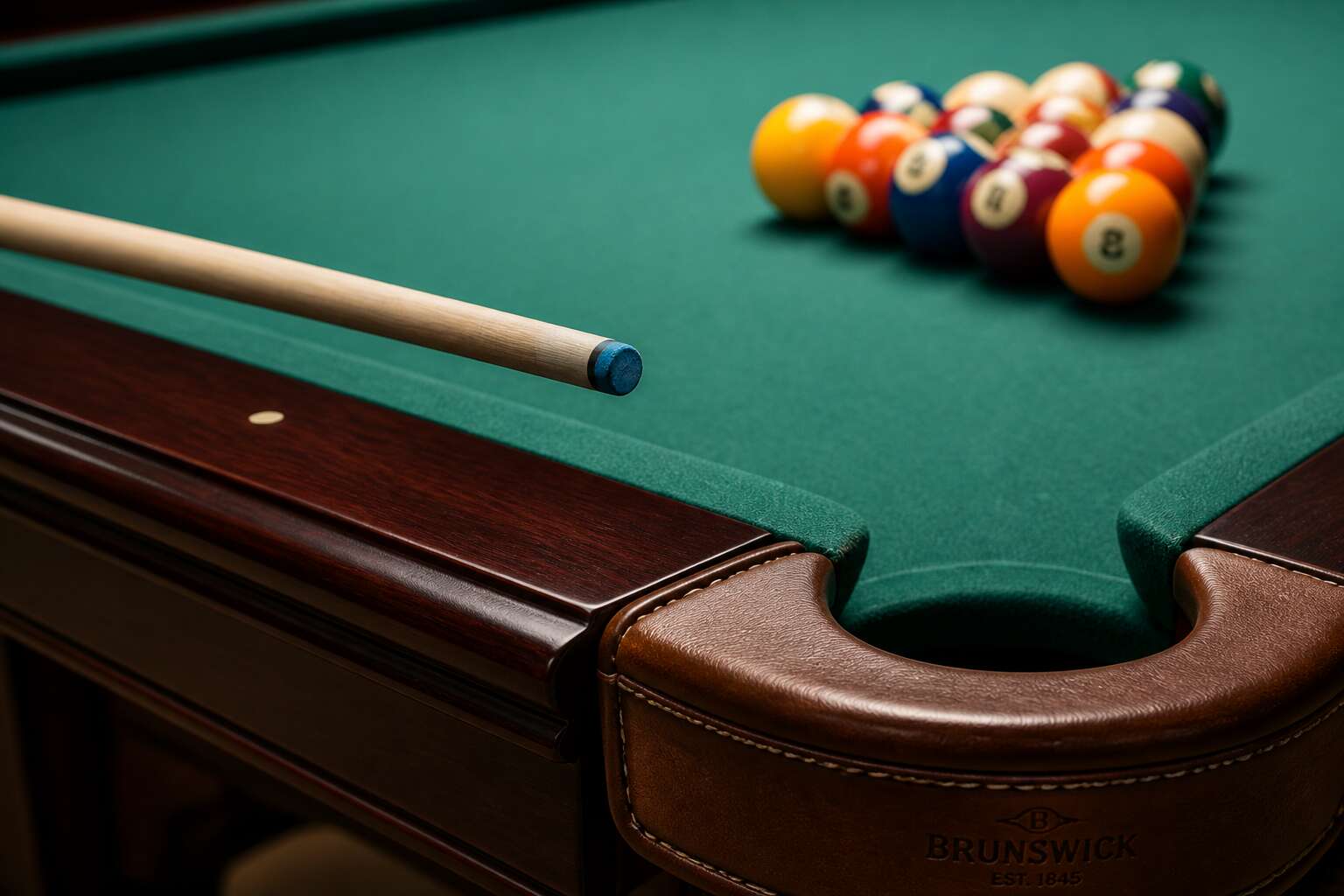
Understanding the Role of Rails in Pool
The Primary Function of Rails: Banking and Deflection
A pool table’s rails are not merely wooden borders; they are the silent architects of every shot you play. When a cue ball meets the cushion, a precise physics equation unfolds. The rubber and cloth combination compresses, absorbing kinetic energy, then returns it with a predictable snap. This rebound action, known as banking, allows skilled players to plan intricate multi-rail paths for position play. Without a consistent, firm rail, the entire geometry of the game collapses into randomness.
Deflection, however, is a separate phenomenon tied to the rail’s rigid structure. A high-quality rail does not move upon impact. If the rail is loose or dead, it absorbs too much power, causing the cue ball to fall short of its intended trajectory. The ratio of rebound speed to incoming speed is known as the coefficient of restitution, and it determines whether a shot feels crisp or sluggish. For any player asking what are rails on a pool table in a practical sense, the answer lies in this dynamic interaction. The rail is a partner in every safety and every break shot.
A rail assembly consists of several critical components that work in concert:
– The wooden subframe, which provides the rigid backbone for the entire structure.
– The triangular or “K” profile rubber, which is glued to the subframe for consistent rebound.
– The cloth covering, which is stretched tight to minimize friction and allow for smooth rail travel.
The precision of these components dictates how a ball leaves the cushion at varying speeds and angles. A slow, gentle roll will grab more cloth and rebound differently than a hard, forceful hit. Understanding this nuance separates a casual player from a strategist. The cushions are engineered to produce a specific bounce, typically angled at 90 degrees across all six pockets. This ensures that when you fire a ball into the middle of the rail, it returns with a consistent velocity and direction, making the game fair and the skill measurable.
Why Rails Are More Than Just Wooden Borders
In the world of cue sports, a table’s cushions often get overlooked, yet they hold the key to unlocking true proficiency. While the slate provides the canvas, the rails are the frame that defines the boundaries of play. For anyone wondering what are rails on a pool table, the answer goes beyond simple wooden edges. They are the engineered components that influence every rebound, shaping the trajectory of the cue ball and determining the success of countless shots.
Understanding their construction reveals why quality matters. A rail is not a single piece but a carefully assembled unit. At its heart lies a rigid timber core, often hardwood, which provides the necessary stability to withstand years of impact. This core is paired with a specially formulated rubber cushion, the profile of which dictates the characteristic bounce. Finally, the entire assembly is wrapped in the same cloth as the playing surface, ensuring a seamless transition. The selection of these parts varies between manufacturers, which is why tables can feel drastically different from one another.
When you step up to take a shot, you are interacting with this entire system. A well-constructed rail offers a firm, consistent response, allowing you to predict the angle of a kick with confidence. In contrast, a table with worn or poorly fitted cushions will produce dead spots, where the ball loses energy unexpectedly. This inconsistency can frustrate even seasoned players. For the discerning enthusiast, the true nature of what are rails on a pool table becomes clear during bank shots and defensive plays, where a fraction of a millimetre can mean the difference between a brilliant escape and handing the advantage to your opponent.
The height and angle of the rubber profile are critical measurements that contribute directly to the game’s integrity. Correct specifications ensure that the ball leaves the cushion with approximately half its incoming speed, maintaining a predictable rhythm. An improperly angled rail can cause the ball to jump or fly off the surface, leading to miscues and unintended scratches. So, the next time you chalk your cue, take a moment to appreciate the silent partners at the edge of the felt. Their craftsmanship is the final arbiter between a chaotic scramble and a calculated, elegant performance.
How Rails Interact with Cloth and Slate
The nose of the cushion must sit exactly 62.5% of a ball’s diameter above the slate. I have seen tables where that measurement is off by a single millimetre, and the difference is unmistakable. This height is the core of what are rails on a pool table. The cloth creates the bridge between cushion and playing bed. It stretches over the timber core, wraps the rubber nose, then runs across the slate under tension. This continuous sheet means the ball never meets a seam.
Beneath the cloth, the subrail bevel controls rebound speed. A shallow angle softens the bounce, while a steeper one snaps the ball back harder. In Johannesburg’s dry winters, timber shrinks and the cushion nose drops slightly. Along the coast, humidity swells the wood. So the geometry of what are rails on a pool table shifts with the seasons.
The cloth face at the cushion absorbs constant impact. A worn weave grabs the ball and kills its momentum. Good rail cloth, by contrast, lets the cue ball leave cleanly.
The Core Anatomy of a Pool Table Rail
The Wooden Rail Frame: Structure and Aesthetics
A pool table’s wooden rail frame must hold the cushion angle within a single degree of precision. Milled from dense hardwoods, this structure supports everything on the table. In South Africa’s humid climate, the wood faces constant expansion pressure. When the frame warps, even a fraction of a millimetre alters the cushion nose. You start missing shots that felt right on contact.
The aesthetic layer is not separate from this function. The rail’s visible profile, that chamfer or rounded edge, emerges from how the wood was cut and joined. I look at the grain to judge the table’s pedigree, and honestly, it never lies!
The frame comprises several distinct parts:
– The nose, where cushion rubber bonds to wood
– The sub-rail, which sets the cushion’s precise angle
– The facing, the timber border framing the play surface
Understanding what are rails on a pool table begins with this wooden frame.
The Cushion Rubber: The Heart of the Bounce
The cushion rubber determines everything about how a ball leaves the rail. Most modern rails use a triangular profile of vulcanised rubber bonded to the sub-rail. The nose’s height and the rubber’s durometer, its hardness rating, control the rebound speed. A table set for tournament play typically has cushions that return a ball with a consistent, almost deadened feel. I have seen worn rubber that turns what are rails on a pool table into unpredictable hazards. When the rubber oxidises, it loses resiliency and develops flat spots.
Here is what separates good cushion rubber from the rest:
- The contact point must be exactly 62% of the ball’s diameter above the slate.
- The rubber’s internal density must be uniform across its length.
Without these, a bank shot becomes a guess.
Understanding Cushion Profiles (K-55 vs. K-66)
The true character of a pool table reveals itself in the geometry of the rail, a detail often overlooked by the casual player but immediately felt by the seasoned enthusiast. When we ask what are rails on a pool table, the answer lies not just in the wood but in the precise angular cut of the cushion, known as the profile. These profiles are the blueprint for every rebound.
There are two dominant standards in the industry, K-55 and K-66, and their numbers refer to the specific degree of the angle where the rubber meets the sub-rail. The K-55 profile is the traditionalist’s choice, offering a livelier, more direct return that suits faster cloth and a firmer stroke. The K-66 profile, in contrast, presents a slightly larger surface to the ball, which tends to absorb a touch more energy, providing a softer, more controlled deflection that many players prefer for detailed position play.
Understanding what are rails on a pool table ultimately comes down to this specific combination of rubber density and nose height. To break it down further:
– K-55 Cushions: Deliver a quicker, more sensitive response, ideal for players who want immediate feedback.
– K-66 Cushions: Provide a more gradual, forgiving reaction, smoothing out the pace of the ball.
So when you consider what are rails on a pool table, remember the cushion profile is the signature of the table’s feel. It dictates the difference between a bounce that feels sharp and precise versus one that feels deep and muffled. Matching the right profile to your playing style is as crucial as choosing the right cue, because it defines the dialogue between the ball and the rail.
The Function of Diamond Sights on Rails
The core anatomy of a rail starts with the subrail, the wooden base cut to receive the cushion. That angle is the first determinant of the rebound. The rail cap covers this junction and carries the diamond sights, which are more than ornamentation. I have seen players treat them as navigation aids, and honestly, they are. For the uninitiated, what are rails on a pool table often becomes clearer when you understand these markers:
- They divide the rail into equal segments for bank shots.
- They give you a repeatable target for kick shots.
- They connect your eye to the table’s true geometry.
Sights made from mother of pearl or acrylic sit flush in the wood. Each diamond corresponds to a specific position on the cloth. Once you learn to read them, the rail becomes a consistent measuring tool.
Types of Rail Cushions and Materials
Natural Rubber vs. Synthetic Rubber Cushions
Some players obsess over slate flatness, yet the cushion material remains the most decisive factor in a table’s true character. What are rails on a pool table without rubber that answers precisely? The composition of that rubber dictates whether a ball sings off the face or dies upon arrival. Natural rubber offers a lively, consistent rebound that many purists demand. It provides a familiar, articulate click upon impact and delivers predictable energy return for controlled positional play. However, this living material demands constant environmental pampering. Heat and humidity in Johannesburg or Durban can alter its firmness and speed considerably.
Synthetic rubber cushions, often crafted from compound blends, offer superior resilience and uniformity across varying climates. They are engineered to retain their bounce and profile for years without the fatigue that plagues natural gum. For the club owner, this means less maintenance and a more consistent playing experience for leagues. For the casual player, it means a table that feels the same in autumn as it does in summer.
– Natural rubber: Superior responsiveness, yet sensitive to temperature swings.
– Synthetic rubber: Durable consistency, ideal for high usage or humid environments.
So, when you query what are rails on a pool table and search for the perfect stroke, remember that the nuanced difference between these materials defines the soul of the table, transforming a simple bank shot into a timeless exercise in physics. The choice ultimately mirrors the player’s own temperament; one demands a raw, immediate conversation with the cue ball, while the other prefers a reliable, unflinching partnership.
Firmness Levels and Their Effect on Play
Cushion firmness creates a spectrum of play that many newcomers overlook. A soft cushion compresses noticeably on impact, extending contact time and muffling the feedback for a gentler response. A hard cushion offers immediate pushback and demands more precision in your follow-through.
The modern market offers several main types:
- Low profile cushions with a flat face for energetic games
- Semi-profiled cushions balancing give and resistance
- High profile cushions prioritizing consistent rebound
Your local climate affects everything here too. When players ask what are rails on a pool table, they often miss the firmness variable that changes everything about bank shots.
Tournament Grade vs. Recreational Grade Rails
Tournament grade rails demand exacting tolerances. The rubber density is measured and matched across all six cushions, guaranteeing identical rebound on every bank shot. Recreational tables may employ comparable materials but with wider variance, so each rail plays slightly differently. This distinction matters in Johannesburg’s climate, where heat alters performance.
The wood beneath the cloth carries equal weight. Tournament rails use kiln dried hardwoods that resist warping under humidity. Recreational rails often rely on laminated boards that suffice for social play but flex over time. I have seen recreational rails fail within a year of installation. Common materials include:
- Solid hardwood, preferred for stability
- Engineered wood, balancing cost and consistency
- Aluminium extrusions, reserved for high precision models
When players ask what are rails on a pool table, they rarely consider grade. Yet it determines whether a table plays true for a decade or begins to misbehave within months.
How Rail Height Affects Ball Rebound
What are rails on a pool table? They are the wooden frame bordering the playing surface, but that simple description hides their true purpose. The rail is the silent partner in every shot you take. It is the only thing standing between your cue ball and the floor, and more importantly, it is the tool you use to bend the geometry of the game to your will. Players often obsess over the cloth and the slate, but the rail is where the science of the game comes alive.
When you send the cue ball into the cushion, you are not just hitting a piece of wood. You are compressing a rubber core and watching it release that energy back into the ball. This interaction dictates the speed and the angle of the rebound. A rail that is too soft will swallow the ball’s energy, leaving it dead and short. A rail that is too hard turns the table into a pinball machine, spitting the ball out with unpredictable velocity. The true craft lies in the balance, and that balance starts with the rail height.
The height of the cushion is a critical specification that often gets overlooked. If the rail is too high, the ball will make contact below the equator, driving it down into the slate. This kills the rebound and creates a lifeless, heavy feel. If the rail is too low, the ball will contact above the equator, causing it to launch upward. This creates a dangerous, airborne trajectory that loses speed and accuracy. The precise point of contact is designed so the ball transfers its spin into the cushion, allowing for that controlled, smooth return. This is why even the finest cloth cannot fix a table whose rails have been installed at the wrong elevation.
The engineering behind this rebound relies on the specific profile of the rubber. There are two dominant shapes in the industry, designated as K-55 and K-66. These numbers refer to the geometric angles of the rubber nose. Each profile interacts with the ball slightly differently. The K-55 tends to offer a firmer, more direct reaction, which is often preferred for faster playing conditions. The K-66 is typically a bit more forgiving, offering a slightly softer touch that can help control the ball on harder surfaces. Choosing the right profile is essential because the cushion must match the speed of the cloth and the characteristics of the slate to create a cohesive playing environment.
Once you move past the geometry, the material composition of the rubber becomes the next great divide. Natural gum rubber is the traditional choice. It provides a classic, authentic feel that many purists swear by. It has a lively, responsive nature that rewards precise timing. However, synthetic rubber compounds have advanced significantly. These are engineered to resist changes in temperature and humidity, which is a massive advantage in a country like South Africa, where the climate can shift dramatically between the coast and the Highveld. A synthetic cushion will hold its rebound characteristics for years, whereas a natural rubber cushion might need more attention to maintain its original performance.
These rubber elements must be permanently bonded to the wooden rail itself. This is where the quality of the wood becomes the foundation of the entire structure. The rail has to withstand the constant impact of 6-ounce balls traveling at high speed. If the wood flexes or warps, the cushion will not sit true, and the rebound will become inconsistent across the table. This is the dividing line between a recreational toy and a professional instrument.
Manufacturers build rail cores from different materials to manage this stress. Solid hardwood is the gold standard for stability. It does not give, which means all the force from the ball goes into the rubber and back out again, creating a predictable and honest rebound. Engineered wood products, like high-density plywood or MDF, are often used in more affordable tables. They are cheaper to produce and can be very consistent, but they might not have the long-term resilience of a solid timber piece. The best tables use a laminated construction, where multiple layers of wood are glued together with opposing grains. This creates a structure that resists twisting and warping far better than a single piece of wood ever could.
So, what are rails on a pool table in the grand scheme of the game? They are the arbiters of control. The cushion takes the raw kinetic energy of your shot and returns it to you, shaped by its height, its profile, and its materials. You can have championship cloth and perfectly level slate, but if the cushions are not up to par, the table will lie to you. It will make you miss shots you should have made and leave you chasing a consistency that the equipment simply cannot provide. The rail is the partner you never see, but you feel it on every single shot. It either gives you the confidence to spin the ball with precision, or it makes you pay for every mistake.
How Rail Quality Impacts Gameplay Performance
The Physics of a Consistent Rebound
A rebound is only as trustworthy as the cushion that produces it, a truth that separates a serious cue sport enthusiast from someone merely pushing balls around. When you consider what are rails on a pool table, you are really asking about the precision of the bank shot. The cushion rubber must return energy with near perfect fidelity. A dead spot on the rail absorbs the impact, turning a planned three cushion escape into a sad, timid roll that stops three inches from the object ball. This inconsistency is the enemy of pattern play.
The physics here are not forgiving. A ball striking the cushion at a specific velocity will transfer kinetic energy into the rubber. That energy stores momentarily and then releases, launching the ball back into the field of play. If the rubber is old or the profile is wrong, that release is mushy and unpredictable. You lose the sharp, crisp snap that defines a professional table. For a player banking a ball down the table, a consistent rebound is the difference between a brilliant safety and leaving the opponent a wide open shot. The rail is not passive wood; it is an active partner in the shot, and a poor partner ruins the dance. This is the core of what are rails on a pool table, a component that dictates the rhythm of the game. A mismatched set of cushions creates a lottery, where the same stroke yields different outcomes based on where the ball lands. No amount of spin or skill can compensate for a cushion that lies about the angle of the return.
Worn Rails and the ‘Dead Bounce’ Effect
Worn rails produce false rebounds. A player calculates the angle, applies the correct pace, and watches the object ball die against a cushion that offers no fight. This dead bounce effect is not subtle. It changes the geometry of the game because the return angle collapses when the rubber loses its resilience. Understanding what are rails on a pool table means understanding that a cushion degrades with every impact, until the table no longer rewards precision.
- Mushy rebounds on delicate cut shots
- Visible flat spots along the cushion profile
- Bank speeds that change from one rail to the next
Rail quality determines whether a safety lands frozen to the cushion or drifts into the open. When you ask what are rails on a pool table, the answer includes this variance. A high quality rail returns the ball with the same energy it received. A worn rail absorbs that energy, then releases it at a lower speed and a flatter angle. Players adapt by playing softer, by checking the cushions for dead spots, by altering strategy to compensate for the equipment.
The Impact of Rail Speed on Shot Control
When a player asks what are rails on a pool table, the practical answer involves consistency. A rail that returns energy predictably becomes an extension of intent. Quality cushions give a reliable reference point. The ball leaves at a speed that matches your input, allowing you to plan position with confidence.
Rail speed dictates shot control. A firm rail returns the ball quickly, preserving both angle and pace. A slower rail, one with degraded rubber or improper tension, eats momentum. The ball comes off short, and position play unravels. Understanding what are rails on a pool table includes this relationship between rebound speed and shaping the next shot.
The consequences appear in specific situations:
- Playing a safety requires the object ball to settle near a cushion. Return speed determines whether it stays or drifts into the open.
- Drawing the cue ball off a rail demands trust in the rebound. A sluggish rail causes it to check up early, leaving you out of line.
Why Professional Tables Demand High-Performance Rails
Ask any serious player what are rails on a pool table and they will likely discuss the importance of a consistent rebound. The truth is that the quality of the rail dictates a player’s trust in the equipment. A high-end cushion provides immediate tactile feedback. This feedback allows for precise cue ball control on every stroke. Without this, the game becomes a series of guesses, where the player must constantly adjust for faulty equipment.
Professional tables demand high-performance rails because the margin for error is microscopic. A tournament player calculates position paths and spin application with near mathematical precision. The rail must return this energy without any loss of momentum. Subpar rubber can introduce a variable layer of unpredictability, turning a comfortable win into a bitter defeat. The very structure of offensive and defensive play relies on the assumption that the rail will behave identically each time.
Inconsistency in the cushion profile forces a player to alter their natural stroke, creating hesitation. A rapid-fire response allows for creative shot making; a sluggish rail kills this spontaneity. The following impacts are significant for a professional’s routine:
- Reliable banking angles for safety play.
- Confidence in the position zone after breaking a rack.
- Consistent speed to execute two and three rail position routes.
High-performance rails are not a luxury, they are a standard for competition. They serve as the silent partner in every match. The answer to what are rails on a pool table, at this level, is a clear reflection of the game’s need for absolute certainty between the ears.
Maintenance, Repair, and Replacement of Pool Table Rails
Signs Your Rails Need Attention
Understanding what are rails on a pool table is the first step to preserving your investment. These cushioned borders do more than keep the balls from flying off; they are the silent architects of every bank shot and position play. Maintaining them is not just about cosmetics, it is about the very soul of the game.
Routine maintenance is simpler than you think. A microfiber cloth and a gentle wood cleaner are your primary tools. You should wipe down the rail caps after every session to remove chalk dust and hand oils. This prevents the finish from dulling and keeps the wood from drying out. For the rubber cushions, a lightly dampened cloth is all you need. Avoid harsh chemicals at all costs, as they can degrade the rubber’s rebound properties.
However, even the finest craftsmanship succumbs to time. Knowing the signs of wear can save you from a frustrating game. Listen for a dull thud instead of a crisp snap when the ball contacts the cushion. This is the first whisper that the rubber has lost its elasticity. Visually, inspect the cloth where it meets the cushion. If you see a crease or a raised line, the rubber is likely compressing and failing.
Repair is possible for minor issues, but replacement is often the better path. A loose rail can sometimes be fixed by tightening the bolts from underneath the table. Yet, a cracked rubber cushion cannot be glued back to life. You must replace it. The process involves removing the wooden rail, stripping the old cloth, and installing a new cushion. It is a delicate job that requires precision with a staple gun.
So, when do you commit to replacement? If the cushion feels hard as a rock or spongy to the touch, it is time. Another key indicator is inconsistent ball behavior. If a ball bounces differently on the same rail, the profile of the cushion is damaged.
Keep your eyes open for these needs:
– Check for loose rail bolts every six months.
– Inspect the cloth for ripples or tears near the cushion.
– Test the cushion’s rebound with a ball from a set height.
If you decide to tackle a replacement, be precise. The adhesive must be spread evenly and the cushion pressed firmly into the rail’s back plate. This step dictates the accuracy of the rebound. A slight misalignment can make the table play “short” or “long.” After replacing, the rail must be re-clothed to complete the restoration.
The signs that replacement is unavoidable are usually clear. Severe damage from impact or water exposure means a full swap. If the wood itself is warped, no amount of rubber work will fix the play. In that case, a complete rail assembly is necessary. This ensures the structural integrity returns. So, when you face a dead rail, you know it is time to revive the heartbeat of your table.
Cleaning and Preserving Rubber Cushions
The rubber cushions on a pool table respond to their environment as much as to play. In South Africa’s variable climate, temperature swings alter cushion firmness. Knowing what are rails on a pool table means understanding these materials. A room that gets too hot accelerates the loss of natural oils in the rubber. Cleaning rubber cushions properly means using mild soap and water, applied with a soft cloth, then wiped dry immediately.
– Direct sunlight degrades the rubber compound over time.
– Humidity can weaken the bond between rubber and rail.
– Dust and chalk residue act as abrasives on the cushion face.
Periodic inspection of the cushion’s bonding to the wooden rail is part of maintenance. The adhesive layer can separate quietly over time. Repair involves reapplying contact cement, but replacement becomes necessary when the rubber has crystallized or cracked. This is where a practical understanding of what are rails on a pool table becomes essential. Replacing a cushion requires removing the rail from the slate, stripping the old rubber, and pressing the new one into a clean, dry channel.
Step-by-Step Guide to Replacing Rail Cushions
Under harsh South African sunlight, a cushion’s life is measured in years, not decades. When that rubber finally hardens into a glossy, unyielding ridge, the rail itself becomes a liability. Understanding what are rails on a pool table means accepting that the wood is merely a host for the rubber. The marriage fails when the adhesive gives way, or the cushion face cracks from constant, unforgiving impacts. Replacement is a precise ritual. You must strip the old rubber, clean the channel of every trace of glue and dust, and dry it thoroughly. Any residue creates a high spot, a subtle irregularity that sends the cue ball on a rogue path.
Applying new contact cement requires a steady hand for even coverage. Let it become tacky to the touch before seating the cushion. The pressure must be uniform along the entire length. Here is the typical sequence for a full rebond:
1. Remove the rail from the slate.
2. Pull the old rubber from the wooden channel.
3. Scrape and sand the channel to a bare, clean state.
4. Coat both the channel and the new cushion back with fresh adhesive.
5. Press the rubber in, starting from the center and working outward.
6. Clamp for 24 hours.
This is where the raw mechanics of what are rails on a pool table become tangible. The clamp pressure must be firm enough to bond without crushing the rubber profile, as a deformed cushion will never rebound true. Patience here is the only cure for a dead bounce.
When to Call a Professional vs. DIY
Knowing whether to tackle a repair or call in a professional often comes down to the question: what are rails on a pool table made of, and how complex is the job? For a simple cushion swap, you might be tempted to DIY. But a full rail replacement involves precise alignment and specialized tools for stretching the cloth.
Let’s be honest: the line between a weekend project and a costly mistake is thin. If your table has leveling issues, a loose joint, or the sub-rail angles are slightly off, you will struggle. A professional has the jigs and the experience to ensure the cushion nose height is exact, which is critical for true ball rebound.
You can safely handle certain tasks, such as:
– Replacing the cloth on the playing surface.
– Replacing the cushions if the rail structure is sound.
– Tightening loose bolts that secure the rail to the slate.
However, you should call a professional if the wood is cracked, the rail is warped, or the old adhesive refuses to release without damaging the substrate. Attempting to force a new cushion onto a damaged rail will just ruin the new rubber. A pro can also assess whether the “what are rails on a pool table” question extends to the internal backing, which might need shimming.
Ultimately, your skill with a staple gun matters less than your ability to measure correctly. In South Africa, where humidity swings can affect wood, a technician will know how to account for that. Saving a few hundred Rand on a DIY job is pointless if you have to pay double to fix the sagging pockets and uneven banks later.

0 Comments