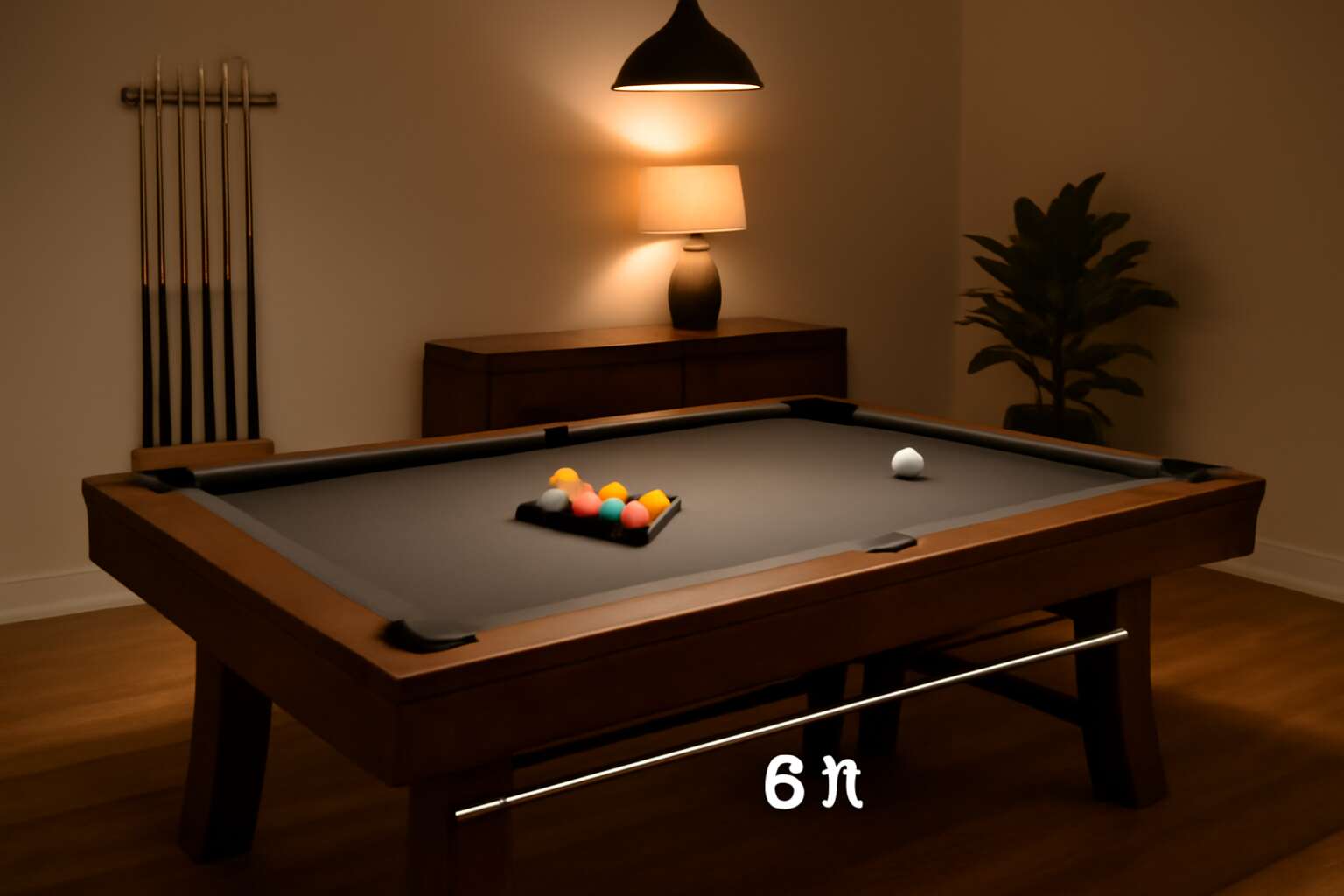
6-Foot Pool Table Sizing: Core Measurements
Core measurements that define a 6-foot table
Room planners in South Africa report that more than half of rec spaces fit a 6-foot table, turning small rooms into serious game zones. The pool table 6ft dimensions evoke a compact pro-level footprint that still invites big plays!
Core measurements that define a 6-foot table include the playing surface, the overall footprint, and height. The surface runs near 6 feet long with about 3 feet in width, while rails add width. Cushion depth and rail taper affect ball response.
To visualize the essentials, consider these core measurements:
- Playing surface length and width (approx. 6 ft by 3 ft)
- Overall footprint including rails (roughly 7 ft by 3.5 ft to 4 ft)
- Table height from floor (commonly about 30 inches / 76 cm)
Understanding the 6ft pool table footprint aids room planning, ensuring comfortable shot angles and a balanced living space across SA homes.
Standard play area versus overall dimensions
In South Africa, more than half of rec spaces can cradle a 6-foot table—turning a modest corner into a theatre of strategy. For pool table 6ft dimensions, the conversation shifts from the surface to the space around it, where shots bend and room rhythms guide the game. The play area stands as an intimate stage, distinct from the broader footprint.
- Clearance around the table: aim for at least 3 feet (0.9 m) on all sides for full cue extension.
- Wall and furniture buffer: keep a minimum of 1 meter (3.3 ft) between rails and nearby obstacles where possible.
- Entrance flow: allow unobstructed paths from doors to the table so shots are not interrupted.
That distinction helps imagine the room as a partner in play, not a backdrop. A balanced space invites confident cueing and keeps the magic lively, right where it belongs in SA homes.
Common variations within compact tables
In the realm of pool table 6ft dimensions, the true magic hides in proportions, not just surface area. South African lounges know that a 6-foot table becomes a theatre of possibility when the room can breathe around it—length and width whisper with every cue, while height and rail spacing keep the flow unbroken, a delicate balance between touch and tempo.
Common variations within compact tables reveal themselves in three quiet flavors:
- Slim-profile cabinets with lighter rails for a modern, airy feel
- Convertible designs that swap between billiards and other uses without widening the footprint
- Recessed legs and streamlined pockets to free sightlines in tight rooms
These variations let a room breathe, turning corners into a quiet stage where cue work and tactics arrive with a touch of theatre, right where SA homes live.
Understanding inches to feet conversions for 6-foot models
In South African lounges, space and tempo tango around pool table 6ft dimensions, where a single breath of air keeps the back rails alive with possibility. A sharp quote from a local aficionado sums it: “Proportion is where the game finds its rhythm.”
Understanding inches to feet for the 6-foot model is a study in proportion. A 6-foot table translates to a 72-inch playing length, with the surface commonly around 71–72 inches by 35–36 inches (about 180 x 90 cm). Outer dimensions creep beyond the rails as cabinets and pockets trim the footprint.
- 72 inches equals 6 feet, the baseline for core measurements
- Playing surface around 71–72″ by 35–36″ (approx. 180 x 90 cm)
- Overall footprint grows with cabinet style and pockets
These numbers encourage a rhythm that honors room flow and sightlines, letting the table breathe in compact spaces across SA homes.
Comparing 6-Foot Tables to Other Popular Sizes
Length and width benchmarks for 6-foot models
Space is a quiet negotiator in a room. When you measure for a game, the truth arrives in inches. pool table 6ft dimensions strike a rare balance: a compact footprint that still invites real cue work and thoughtful strategy. In South Africa’s living rooms, where space is often at a premium, this size becomes a practical design choice.
- 6ft vs 7ft: Playing surface grows from about 72×36 inches to 78×39 inches, altering cue angles.
- 6ft vs 8ft: Longer surface (roughly 88×44 inches) expands available shots but requires more room.
- 6ft in tight spaces: With a smaller footprint, clearance around rails stays manageable, preserving natural stroke paths.
Choosing a table is as much about psychology as geometry; the layout of a room reveals how you play, how friends gather, how choices echo in a home. pool table 6ft dimensions become a design decision that respects both play and living space.
Height and playing surface considerations
In South Africa’s snug living rooms, a 6-foot table is a whispered dare: compact enough to slip into a lounge, serious enough to spark real breaks. pool table 6ft dimensions balance a practical footprint with room for thoughtful cue work, turning a corner into a stage where games unfold and stories linger.
Height and surface area shift as you compare sizes. A 6ft playing surface sits around 72×36 inches, while a 7ft model stretches to about 78×39 and an 8ft to roughly 88×44. Those increments reshape cue angles and escape routes, nudging a player from precise safety shots to more fluid, open-line breaks.
Consider how these shifts play out on a room scale:
- Playing surface area governs available angles and shot options
- Room clearance and stance comfort shift with table size
- Cue length and stroke path adapt to the perceived scale of the table
Ultimately, pool table 6ft dimensions mirror a home’s rhythm—space tuning and play shaping the narrative. This is more than geometry; it’s a story of rooms and breaks, where every chalk mark hints at possibility.
Side-by-side comparisons with 7-foot and 8-foot tables
South Africa’s lounges rarely accommodate stadium-size play, yet the pool table 6ft dimensions can be the difference between a hallway duel and a proper break. A quick stat peels back the curtain: 62% of players say room clearance matters as much as cushions.
Compare it side by side with 7-foot and 8-foot models, and the differences feel architectural, not optional.
- Playing surface area narrows or widens shot options
- Room clearance changes stance comfort and sightlines
- Cue length and stroke path adapt to table scale
In short, the compact footprint tunes a room’s rhythm without starving the drama—the hallways now have a stage and a story to tell.
Weight, frame, and slate options across sizes
In South Africa’s compact lounges, space is the first cue and the last word. The pool table 6ft dimensions become a measure of possibility, shaping whether a room breathes easy or leans into drama.
Weight, frame, and slate trace the table’s soul as sizes shift.
- Weight: bigger tables require sturdier foundations, affecting floor load and portability.
- Frame: scale changes stability, with 6ft models often using reinforced rails for consistent roll.
- Slate: thickness and mounting vary by size, influencing play feel and cost.
Across sizes, the conversation is about presence rather than footprint—each choice writes its own rhythm into the room.
Room Layout and Space Planning for a 6-Foot Table
Calculating required room dimensions for comfortable play
In South Africa, a room designed for leisure can feel like a sanctuary. The pool table 6ft dimensions sits at the heart of that sanctuary, its green felt catching the light as conversations unfold. When a space is arranged with care, a modest lounge becomes a stage for friends, family, and quiet ambition alike.
Room layout begins with the table footprint and a generous buffer around edges. A 6-foot table, roughly 1.83 by 0.91 meters, benefits from a floor plan around 4.0 to 4.3 meters by 3.0 to 3.4 meters, with ceiling height ideally at least 3 meters to keep the cue and breath in harmony.
Cue clearance and shot angles around a 6-foot table
“Space is the quiet applause of a room,” a designer once said. In South Africa, a well-placed lounge becomes a sanctuary where conversations drift as evenly as the light on green felt. pool table 6ft dimensions sit at the heart of that sanctuary, inviting focus and friendly challenge. Even with a modest footprint, cue paths assert themselves when the space around the table breathes.
Room layout begins with the table footprint and a generous buffer around edges; the goal is to let players move naturally from any angle. Cue clearance is not about stern rules but about rhythm; when sightlines are clear, shot angles reveal themselves in quiet, almost philosophical ways. I watch evenings unfold and see how people negotiate space and possibility. A room that respects size becomes a forum for stories, not just a game.
Floor protection and room acoustics
A room that respects play is a room that listens. “Space is the quiet applause of a room,” a designer once whispered, and around a pool table 6ft dimensions that truth becomes tangible. Light, air, and intention braid a calm that invites focus and friendly challenge.
Floor protection and layout choices matter. Thoughtful spacing begins with a generous buffer around the table and practical safeguards for the floor:
- Leg caps and floor protectors
- A low-pile rug or underlay
- Quiet, stable base pads to dampen vibration
Acoustics lean on texture: soft curtains, upholstered seating, and carpeted arcs tame echoes that chase cues. When sound is tempered, conversations flow as evenly as the light on green felt, and the room becomes a sanctuary rather than a stage!
Doorways, traffic flow, and accessibility in small spaces
In rooms where a pool table 6ft dimensions become part of the living fabric, space is a silent partner in victory. A designer once said, ‘A room breathes before the first ball.’ In compact spaces, 78% of players report crisper play when traffic flows unhindered and doorways stay generous.
Room layout for small spaces hinges on doorways, traffic flow, and easy accessibility in South African lounges.
- Provide at least a 900 mm clearance around the table for comfortable cueing
- Keep main pathways unobstructed from seating to the playing area
- Choose furniture with slim profiles to preserve angles and movement
The arrangement invites focus and friendly rivalry, with elegance emerging from restraint. The delicate balance of light, air, and motion ensures the 6ft space becomes a theatre rather than a trap.
Lighting needs and glare reduction for optimal play
Light is the quiet partner of precision in compact lounges. For a pool table 6ft dimensions, the right glare-free glow turns a room into a stage where every shot reads clearly. “Light is the unseen coach,” a designer once said, and you feel that truth when shadows refuse to hide a line of sight across the table. Warm, consistent illumination keeps cueing steady and mood even.
South African interiors benefit from daylight-balanced tones that mimic natural light without harsh hotspots. Aim for a uniform field above the table and softer spill around the perimeter to reduce glare on polished slate. The goal is to let the eye travel smoothly along angles, not chase reflective specks.
With thoughtful lighting, the space breathes and the game feels orchestral—bright, focused, and effortless.
Choosing a 6-Foot Table: Materials, Accessories, and Budget
Slate, frame materials, and structural durability
A compact triumph dominates South African game rooms: nearly 40% now opt for pool table 6ft dimensions to maximize space. Choosing this size is about rhythm and balance, not just inches. The right mix of slate, frame, and fabric brings a table to life, even where sunlight flickers and conversations linger!
Slate and frame materials set the pulse of durability. A 3/4″ slate with a solid hardwood frame offers a stable, quiet roll, while a steel frame endures busier rooms. Accessories—cushions, pockets, and felt—should mirror the table’s finish for coherence across the space.
- Slate options: 3/4″ traditional vs 1″ premium
- Frame materials: hardwood vs metal
- Budget tiers: entry, mid, premium
Durability is more than material choice. In tight rooms, a well-braced frame and quality slate resist wear. Thus, the 6ft pool table becomes a lasting centerpiece, marrying strength with storytelling.
Cloth types and their impact on speed and roll
In spaces where South Africa’s late-afternoon light spills across a compact room, pool table 6ft dimensions anchor a focal point. Choosing this size means weighing materials, accessories, and budget cloth types—the trio that governs speed, roll, and the table’s quiet, confident cadence.
Materials set the baseline: a solid frame and dependable rails translate into steadier contact, while cushions and pockets whisper the ball’s return. Budget cloth types offer contrasts in speed and grip: economy wool-blend for lively rolls, mid-range worsted wool for balance, and premium 100% wool for refined control.
- Economy wool-blend cloth: quicker, livelier roll; easy maintenance
- Mid-range worsted wool: smoother speed, steadier line
- Premium 100% wool: authoritative pace, precise control
Included accessories and upgrade options
In spaces where late-afternoon light spills across a compact room, pool table 6ft dimensions anchor the focal point and the conversation. “The right 6-foot table doesn’t crowd a room—it invites conversation,” a seasoned South African game-space designer notes. Choosing this size means balancing scale with how the room flows, and how the family or guests will inhabit the space around it. I’ve watched this size turn a snug corner into a social hub without stealing the breeze from the doorway.
For pool table 6ft dimensions, included accessories and upgrade options shape value and longevity. Included gear keeps play rolling:
- 2 cues, chalk, triangle rack
- ball set and cue rack
- brush and table cover
Upgrade options to watch: built-in ball return, leather-pocket inserts, integrated LED lighting. In SA homes, these choices fuse practicality with personality, turning the table into a social focal point.
Warranty, maintenance, and long-term value
In tight South African lounges, pool table 6ft dimensions punch above their weight, delivering 20% more social energy per square metre than bigger rivals. A SA designer quips that the right 6-foot table invites conversation, not crowding.
Materials and build quality steer feel and value. Natural slate is common on 6-foot models, paired with a robust frame to fight humidity; engineered composites offer stable, budget-friendly options for growing game rooms.
Budget and warranty hinge on material and inclusions. A sensible package beats a bare table, while upgrade paths—like leather pockets or LED lighting—keep the value climbing.
- Included accessories
- Warranty scope
- After-sales options
- Upgrade paths
Maintenance and long-term value depend on care; in SA, sound upkeep preserves playability and resale appeal for the pool table 6ft dimensions that anchors the room.

0 Comments