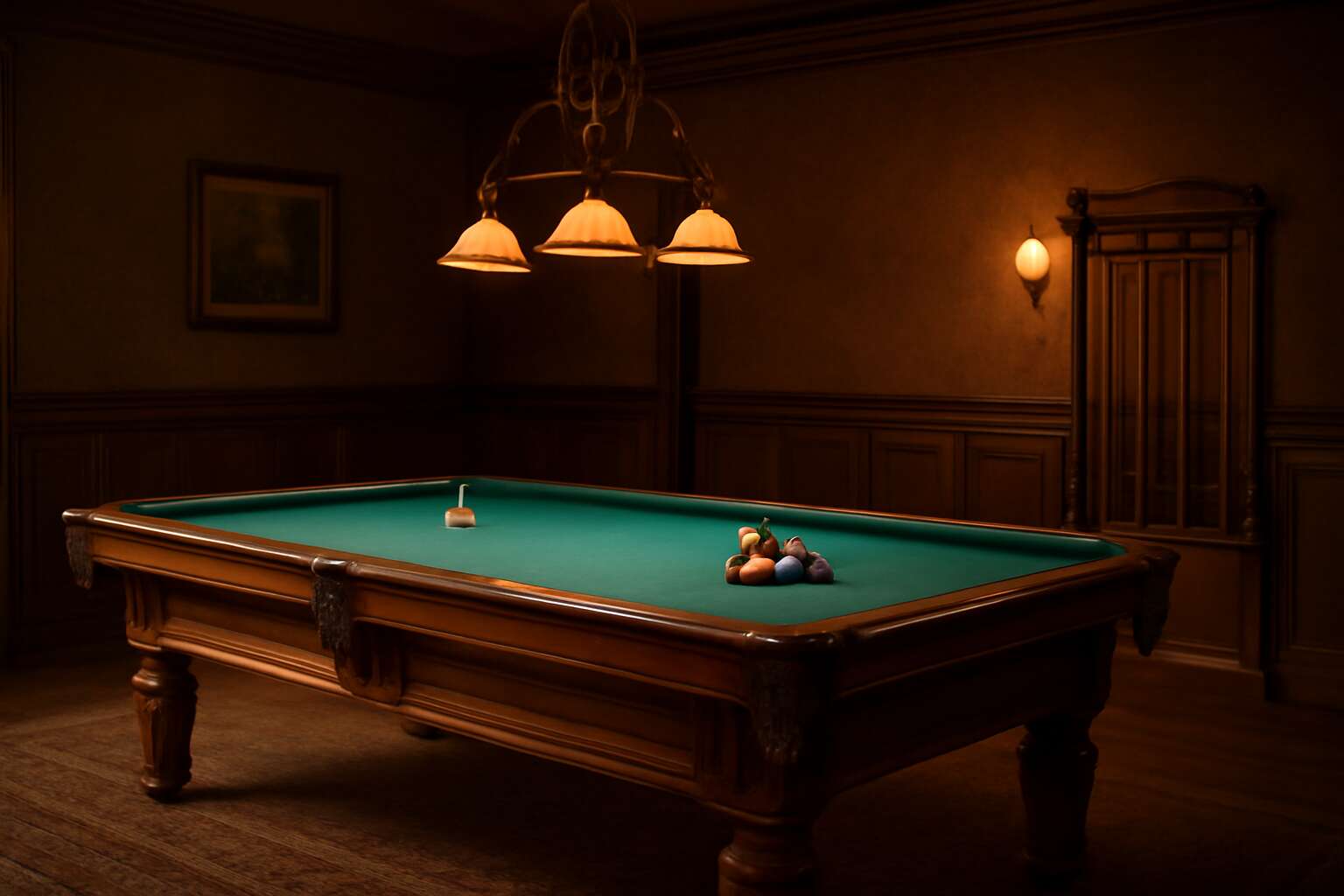
Historical Context of Pool Table Inventions
Origins of cue sports and early table games
Sound travels fast in a billiard hall—chalk, click, and the soft thump of a ball. The arc from lawn games to refined cue sports is long, but the pivot point is clear: when pool table was invented. In South Africa, clubs mirrored this global shift, turning parlour play into organized competition and social ritual. I’ve stood in those rooms and felt the history click into place!
- bagatelle
- billiards
- carom
These ancient forms laid the groundwork for the modern table. The spread of pockets, cushions, and standard cloth followed players and clubs, shaping how the game sits in bars, clubs, and homes across the country today.
From lawn games to indoor entertainment: a turning point
From garden greens to smoky parlours, the transition to indoor cue sports reshaped leisure in South Africa. Lawn games gave way to pockets, cushions, and refined cloth as clubs stitched a new social ritual. The arc—from street games to serious competition—unfolded with quiet precision, turning billiard halls into sanctuaries where strategy and stillness meet.
The question of when pool table was invented marks a pivotal moment in the evolution of the table. In clubs across South Africa, designers fused geometry with hospitality, creating rooms that bustle with debate over shots and safeties. Chalk dust lingers as a reminder of a long arc—from lawn games to indoor entertainment—shaping bars, clubs, and homes today!
Early prototypes and design ideas across Europe and America
Few relics endure with such quiet authority as the green cloth that migrated from drawing rooms to clubs. This is the era when pool table was invented, and chalk sighs as rooms fall into hushed focus. The migration from lawn games to indoor leisure unfolded with quiet precision across Europe and America, turning parlour sport into social theatre.
Early prototypes blurred function and form, and designers chased sturdier mechanisms and sleeker silhouettes:
- European variants experimented with cabinet ornament and early pockets carved from wood
- American tables demanded slate beds, reinforced frames, and robust cushions for rugged rooms
- French billiard rooms codified cloth, ball proportions, and rules that knotted play with etiquette
These threads braided into South Africa’s clubs as well, where imported know-how met local ingenuity, yielding rooms that smell of chalk and ambition, and a ritual that persists in bars, clubs, and homes today.
Materials, craftsmanship, and the emergence of slate as a standard
Behind the velvet hush of a club room lies a stubborn truth: flat, true surfaces decide every shot. The arc of billiards history bends on one hinge—when pool table was invented—yet the leap from sketch to slate took decades of craft and risk. Makers chased consistency as if it were a haunted secret.
Slate, not wood, earned the crown—dense, uniform, and whisper-light to work with. The Welsh quarries whose slabs became beds for parlor kings helped standardize thickness and true plane, delivering what rules, pockets, and cloth later demanded. South Africa’s clubs echoed this evolution, translating European know-how into rooms of chalk and ceremony.
In practice, the convergence of materials and craft can be distilled into a few essentials:
- slate beds
- reinforced frames
- high-density cushions
- premium billiard cloth
The influence of gambling houses and parlors on popularity
A tense hush falls over rooms when the question of when pool table was invented is raised. In gambling houses and parlors, players learned that a perfect surface could turn a break into a narrative of risk and reward. The arc runs from village games to the gleaming parlors of cities.
These venues amplified demand and shaped the table’s myth; consider the forces at work:
- spectators drawn by stakes and drama
- rooms marketed as ritual spaces
- professional players elevating the game’s prestige
In South Africa, clubs, hotels, and social halls carried the same energy westward, weaving billiards into urban life and sporting culture. The game travelled hand in hand with colonial exchange, entertainment districts, and a growing leisure class, turning evenings into ceremonials where chalk sparks stories.
Invention Timeline and Key Milestones in Billiards
From carom to pool: early game transitions
From the shadows of candlelit parlours, the parlor’s heart found a new tempo. The refrain echoes: when pool table was invented, pockets and green cloth beckoned like doors to another realm. By the mid- to late-1800s, tables grew heftier, and a new etiquette threaded through halls from Cape Town to Durban—a ritual that braided skill with spectacle.
Key milestones trace the river from carom to pool.
- Carom-to-pool awakening
- Advent of pocketed play
- Standards emerge for dimensions and play
- Birth of dedicated pool rooms and manufacturers
From those quiet revolutions, the game settled into a modern form that still whispers through South Africa’s clubs. The glow of green felt, the click of cue, and the hush after a perfect break endure.
Standardization of table dimensions and pockets
From the first crack of a cue to a pocketed pastime, the invention timeline reads like a map of clever compromises and bold bets. The story of when pool table was invented shows pockets and green cloth pulling players toward a new stage of skill and showmanship. By the mid to late 1800s, tables grew heftier, slate beds steadied, and a formal etiquette threaded through halls from Cape Town to Durban.
- Advent of pocketed play
- Standards emerge for dimensions and pockets
- Birth of dedicated pool rooms and manufacturers
Those quiet revolutions seeded the modern game, with standard lengths around 9 feet and pocket openings tuned to the balls. In South Africa, clubs from Cape Town to Durban absorbed the new specs, pairing global standards with local polish and the distinctive SA flair that keeps pool rooms lively today.
Notable inventors and patent milestones in the nineteenth century
From the creak of slate to the hiss of chalk, this hints at when pool table was invented—a nineteenth-century timeline of prototypes and patents turning billiards into a calibrated sport.
- 1850s: pocket openings stabilize against the balls
- 1860s–70s: slate beds become standard fare
- 1870s–1890s: patents drive design consolidation
Notable inventors and patent milestones rose from workshops, foundries, and traveling fairs, refining cushions, pockets, and timing mechanisms as manufacturers pushed standards. This ghostly propulsion elevated billiards from pastime to profession, with lingering echoes in today’s South African clubs and a shared sense of tablecraft across continents.
Advances in cloth, cushions, and slate technology
A century of measured fixes turned billiards from a parlor pastime into a calibrated sport. This arc—when pool table was invented—shows refinements accreting through workshops and fairs, echoing today in South Africa’s clubs where tablecraft remains a shared language.
Advances in cloth reshaped the pace and precision of play. Tighter, more uniform baize reduced nap variance, while wool-cotton blends offered durability. The result: steadier rolls and truer bounces, making every match a contest of skill on a reliable surface.
Cushions evolved from leather seams to rubber systems, delivering repeatable rebound and longer life. Slate beds hardened into standard, multi-piece surfaces, guaranteeing flatness and easier maintenance—foundations for professional scoring and consistent play across venues.
- Mass production and quality control of cloth and slate improved consistency across venues
- Rubber cushions and frame engineering delivered repeatable rebound and durability
- Global distribution and standardized dimensions cemented professional play in places like South Africa
The role of manufacturers in shaping modern pool tables
Across a century and a half, hundreds of workshops chipped away at a single goal: a table that plays true. The arc of modern billiards stretches from rough prototypes to the calibrated sport we know today. This helps answer when pool table was invented—not as a single moment but as a lineage of refinements that turned a parlor diversion into a global craft.
Key milestones along this timeline include:
- Factory-scale fabrication transforming bespoke frames into reliable platforms
- Global distribution stitching uniform dimensions, pockets, and leveling systems
- Slate managed as a modular, replaceable core across brands
From South Africa’s clubs to Cape Town parlors, manufacturers’ discipline underwrites every measured break and true bounce. The role of makers, mills, and merchants is the quiet backbone of tablecraft here, a heritage shared across continents and still visible in the quality that South African players expect.
Regional Variations and Global Spread
The British to American evolution of billiard culture
From smoky British clubs to sunlit American parlors, the British-to-American evolution of billiard culture follows a single thread: competition, craftsmanship, and a shared love of tactility. A whisper of chalk and legend drifts through the era—when pool table was invented, the design possibilities exploded, and by 1900, the United States boasted more than 20,000 tables.
- Britain favored heavier slate, longer rails, and slower cloth, cultivating a ritual of precise, methodical play.
- Across America, faster cloth and bigger crowds shaped vibrant pool halls where spectacle met strategy.
- In South Africa, workshops merged local artistry with robust engineering, giving durable frames and ornate finishes for pubs and homes.
Global spread rode railways and ships, turning private parlors into cosmopolitan courts where etiquette varied by town yet the game remained irresistibly magnetic. The British to American arc still guides designers today, reminding us that a table’s soul travels as much as its balls.
Regional differences in table design: slate, cloth, and rails
Sunlit rooms across South Africa carry a quiet rhythm, a regional heartbeat in every pool cue. When pool table was invented, the craft learned to listen—slate, cloth, and rails adjusted to local light, space, and appetite for show. From coastal pubs to inland lounges, designers stitched durability with elegance, letting the table age like a story told in felt.
- Slate preference shapes tone and stability under pressure
- Cloth choice influences speed, friction, and cue feel
- Rails and pockets reflect regional usage and craftsmanship
Global spread rode railways and ships, turning private parlors into cosmopolitan courts where etiquette met engineering. Those regional traits still inform South African showrooms, helping designers coax character from every room while honoring local light and space!
How American pool halls influenced standardization
In American pool halls, a quiet revolution unfolded as tables shifted from artisanal pride to shared instruments of competition. That pivot ties to the moment when pool table was invented, a drift toward durability and a dependable cue feel that could endure crowds and bets. South African showrooms now mirror that history, translating imported ideals into setups that respect local light and space.
- Rugged durability for high-traffic rooms
- Consistent components and easy sourcing across brands
- A uniform feel that lets players trust the table anywhere
That cross-continental thread continues to shape design decisions in Cape Town and Johannesburg, where slate, cloth, and rails are chosen to honor both American rigor and local conditions. The result is rooms that feel familiar to visiting players yet resonate with South African light, space, and social rhythm.
Snooker, pool, and billiards: overlapping traditions
Across South Africa and beyond, regional variations in billiards reveal a shared hinge in history. A Cape Town club owner whispers, “The table is a quiet book,” and you feel how light and social rhythm write different chapters on the same slate. The question of when pool table was invented sits at the heart of that story—a moment when durable construction and a dependable cue feel let crowded rooms become a national pastime.
Regional flavors appear in threads across hemispheres:
- layout decisions driven by space and daylight in Cape Town rooms
- cloth, slate, and rails adapted for local foot and hand pressure
- service culture and social pace influencing accessibility and maintenance
From the dust of early parlours in Europe to modern showrooms in Johannesburg, the global spread of snooker, pool, and billiards shows overlapping traditions that translate into something immediately familiar yet distinctly local.
International organizations and global adoption
“The table is a quiet book,” whispers a Cape Town club owner. Across continents, the slate remembers the moment durable craft met social ritual. The question of when pool table was invented threads through history, a hinge that links parlour magic with clubroom science. Regional flavors surface in Cape Town layouts, cloth and rails tuned to local touch, and service pace that choreographs accessibility!
- Cape Town: daylight-informed room layouts
- Cloth, slate, rails tailored to local rhythm
- Service culture shaping access
From Europe’s parlours to Johannesburg showrooms, the global spread is anchored by international organizations and adoption. Bodies such as the World Pool-Billiard Association (WPA) and the International Confederation of Billiards Sports coordinate standards, while regional federations drive the rollout of uniform pockets, slate, and cloth. In South Africa, clubs weave these global threads into local craftsmanship, gifting a uniquely South African flavor to the universal game.
Cultural Impact and Modern Demand
Pool tables as social hubs in homes and venues
In South Africa, a well-placed game space can transform gatherings into shared adventures. The moment when pool table was invented didn’t just add a pastime; it stitched social life into the fabric of rooms, turning any corner into a stage for friendly rivalries and warm storytelling.
Across homes and venues, pool tables serve as social hubs—centers for laughter, strategy, and connection.
- Warmth of conversation grows as cues click and balls scatter
- Generational bridge, inviting both newcomers and seasoned players
- Versatile spaces that fit lounges, kitchens, or dedicated rooms
Modern demand keeps the flame alive—sleek silhouettes, durable cloth, and smart lighting ensure the pool table remains central in both homes and venues across South Africa.
Economic and restoration aspects of vintage tables
In South Africa, three out of five hosted game nights revolve around a pool table, a statistic that hints at how these tables anchor rooms and social rituals. Vintage pieces carry more than wood and slate—they hold shared memories of clubs, lounges, and family games. The moment when pool table was invented transformed the room into a stage for conversation, strategy, and storytelling; today those lines invite newcomers into a warm cadence of play. Modern demand keeps the flame alive with sleek silhouettes, durable cloth, and smart lighting that suit lounges, kitchens, or dedicated corners.
Economically, vintage tables are more than nostalgia—careful investments shaped by provenance checks and restoration skill, supporting local workshops and dealers across SA.
Key factors for enduring value:
- Provenance
- Cloth and slate condition
- Climate care
How table design affects popular games and playstyles
Across South Africa, the pool table isn’t just furniture—it’s a social hinge. I’ve watched rooms shift under the glow of green cloth as players trade chalk, stories, and wagered glances. The question of when pool table was invented becomes less a date and more a doorway into conversation, strategy, and shared memory.
Design choices—how the table sits in a room—shape which games dominate and how players move.
- Cloth speed and friction steer break patterns and run-outs.
- Table height relative to seating alters cue reach and safety play.
- Pocket size and rail geometry guide defensive play and positional planning.
Today, modern demand favors sleek silhouettes, durable fabrics, and smart lighting that turn lounges, kitchens, or dedicated corners into theatre spaces for cue sports. These design cues quietly expand playstyles—from tactical safety games to high-pace attack—while preserving the table’s role as a social hub in homes and venues across South Africa.
The online era: knowledge sharing and community building
Across South Africa, a late-evening gathering around a green cloth feels like opening a shared memory. When I hear chalk click and a soft crowd rise with the break, I’m reminded that the story of when pool table was invented is less a date than a doorway to community, resilience, and small-town pride. The online era stitches those rooms into wider circles—knowledge shared, friendships formed, legacies passed along through digital threads.
- Forums and social groups that keep regional tactics alive
- Tutorial videos from seasoned players and clubs
- Live streams and virtual leagues that connect rural lounges with city halls
That cross-pollination reshapes culture and demand, turning the once-private hobby into a living, evolving theatre of skill and storytelling.


0 Comments